

Deep sea mining
The ocean floor is no longer a last resort for minerals. But extraction rules in international waters stand in the way.


Welcome to the Alts Sunday Edition
Hope you enjoyed last week’s issue: Inside The Australian Open. (Congrats to Elena Rybakina and to Carlos Alcaraz on his career Grand Slam!)
Over the past few weeks, deep sea mining has quietly crept back into the headlines.
Japan sits at the center of this story, as it plans to extract critical minerals from the seafloor using new deep-sea mining technology.
This comes at a moment when expanding domestic access to critical minerals is both an economic necessity and a critical geopolitical strategy.
Today we have a short but interesting primer on seabed mineral extraction. We’ll explain how it works, who controls the ocean floor, environmental considerations, and why Japan’s recent move is interesting.
We’ve also got an alternative way for you to invest in critical minerals hidden deep underwater.
Let’s dive in
⚓ Invest in Deep-Sea Treasures (literally)
Recover underwater assets through real maritime salvage expeditions.
Boy do we have an interesting opportunity for you today.
As you’ll see in this issue, seabed mineral extraction is opening big questions about mining the seafloor.
Oceyon operates in an alternative corner of the ocean economy.
They’re a Swiss-based maritime recovery firm, retrieving underwater assets from real shipwrecks using next-gen robotics and AI.
They locate high-value wrecks in international waters (think sunken merchant ships, precious metals, wartime cargo) and recover the treasures under tight legal, operational and environmental controls.

The upside on a successful haul can be enormous.
And this month, Alts is partnering with Oceyon to offer our community direct access to these missions via a revenue-linked note tied to four upcoming recovery campaigns.
🎯 Targets
WWII vessels known to contain silver
A copper freighter in the North Atlantic
Two wartime wrecks in the Mediterranean
🚢 Investment Details (coming soon)
Capital deployed on a project-by-project basis
Milestone-driven structure
Investor participation in upside
Details coming soon
This is one of the most unique and potentially lucrative SPVs we’ve ever put together.
Accredited investors only.
Disclosure: Offers are open to accredited investors only. Oceyon is not a registered broker-dealer or investment advisor. Private investments are illiquid and carry risk, including loss of capital. Past performance is not indicative of future results.
How we got here (a short history)
Deep sea mining feels new because the headlines are new. But the underlying idea is not.
The modern story starts in 1870s, when HMS Challenger dredging expeditions first recovered strange, metal-rich nodules from the deep ocean floor.
But it wasn’t until the 1960s that scientists began to understand what they were actually looking at. Advances in sonar and deep-sea sampling revealed that huge swaths of the seabed, particularly in the Pacific, were carpeted with potato-sized polymetallic nodules formed over millions of years.
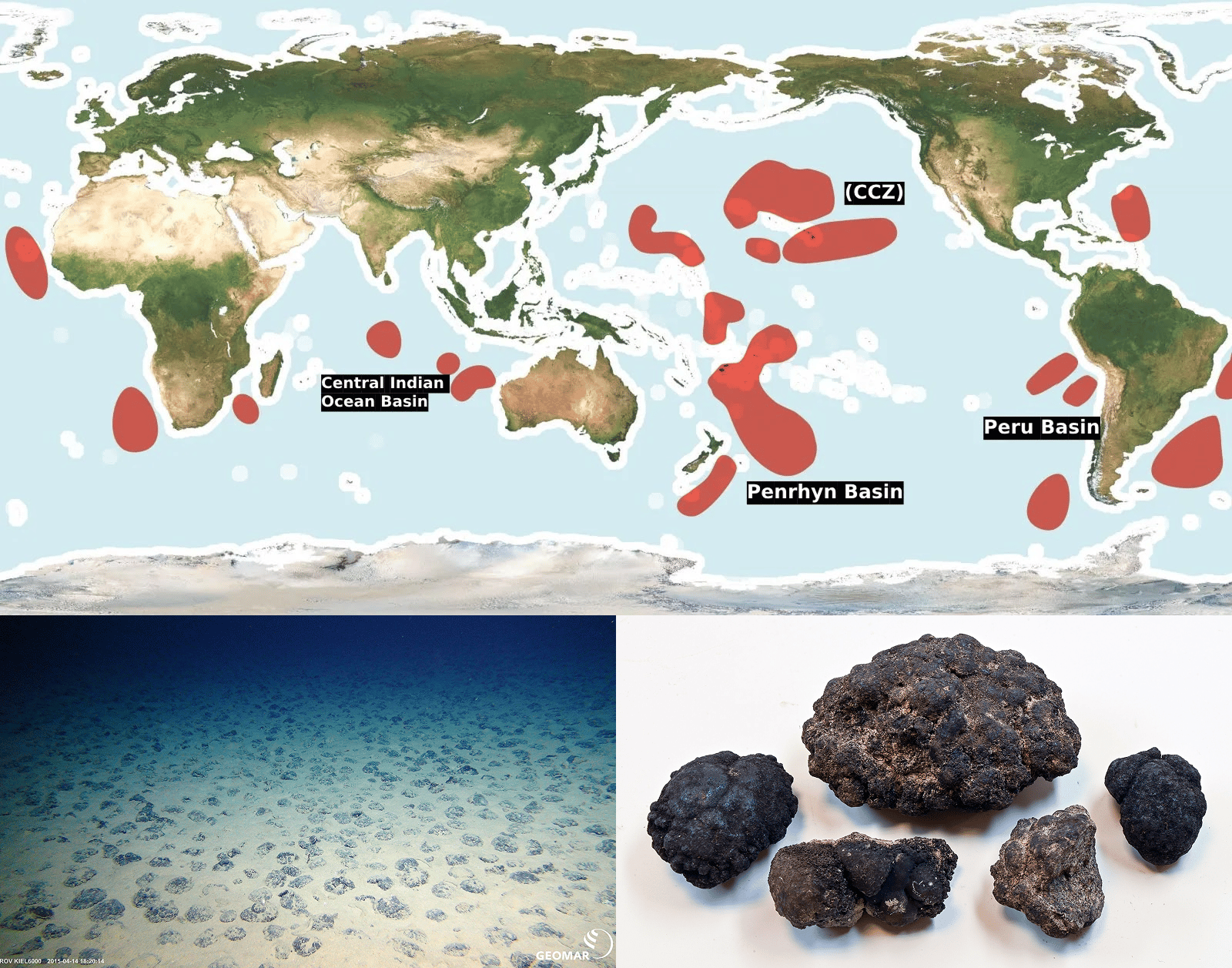
Once researchers realized how widespread these nodules were, interest moved quickly from science to economics. Throughout the 1970s, governments, oil majors, and mining companies spent hundreds of millions funding extraction trials.
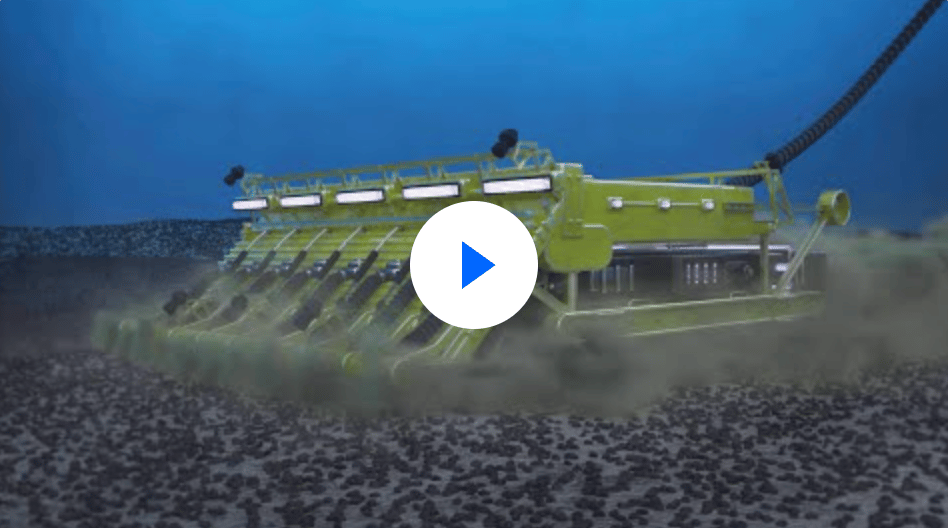
In July 1970, Deepsea Ventures conducted the world’s first deep-sea mining test 300 km off the coast of South Carolina, marking the start of the “nodule rush.” They used a hydraulic suction dredge to collect manganese nodules, and a continuous lift system to get them to the surface.
Why the seafloor mining industry never scaled
The process worked. So why hasn’t seafloor mining turned into a bigger industry?
Well, a few practical realities got in the way.
The economics were brutal
Offshore operations were expensive, and profitability depended on long-term metal prices cooperating in very specific ways.
The engineering was unforgiving
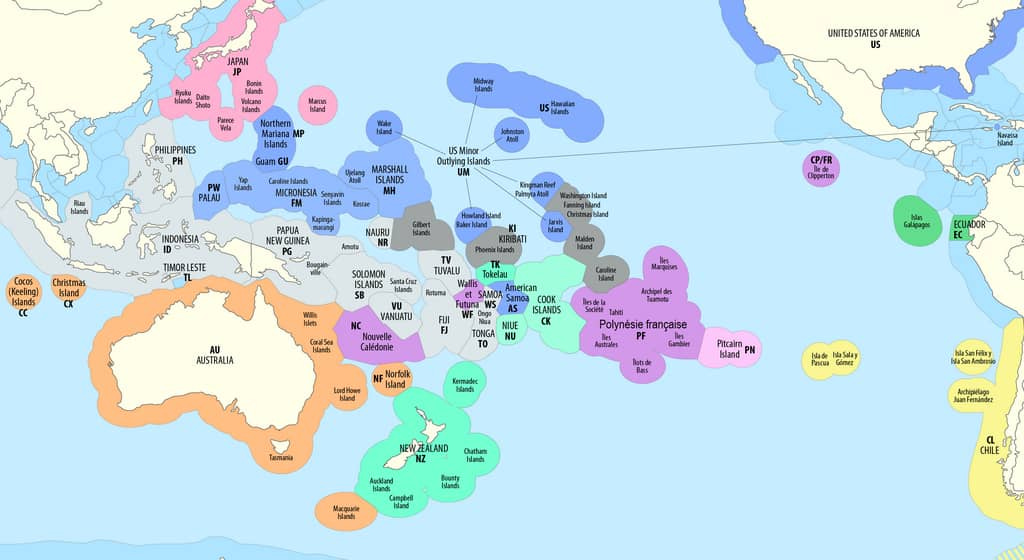
Deep sea mining is conceptually simple but operationally hard. Operating reliably several kilometers underwater left little margin for error, and failures were costly.
Onshore supply was just easier
Deep sea mining only replaces the extraction step, refinement is still a huge cost. Land-based mining was cheaper, familiar, and already embedded in global supply chains.
Collecting nodules for a few days is one thing. Running equipment reliably for months, in deep water, far from shore, with predictable costs and throughput, is something else entirely.
The legal and political framework lagged
This last point is critical.
After the 1970 pilot tests, countries without the capital or technical capacity to pursue deep sea mining began pushing for an international legal regime that would govern access to the seabed, redistribute economic benefits, and require the sharing of mining technology.
Unsurprisingly, this push ran directly into resistance from industrialized nations & companies that had already invested heavily in exploration and equipment.
The result was prolonged disagreement over ownership, licensing, and authority in international waters. Those disputes dragged on just as metal prices weakened and technical challenges piled up.
By the early 1980s, the combination proved harmful. Without clear answers on who could mine, where, and under what rules, deep sea mining stalled before it could turn into a durable industry.
Who owns the ocean floor?
Before getting to Japan, we need to clarify one important point: there is no single legal regime governing the entire ocean floor.
There are two distinct jurisdictions:
Inside a country’s exclusive economic zone (EEZ), where national laws and regulators apply.
In international waters, where the rulebook is global, slow-moving, and still unfinished
Japan is testing in its own waters
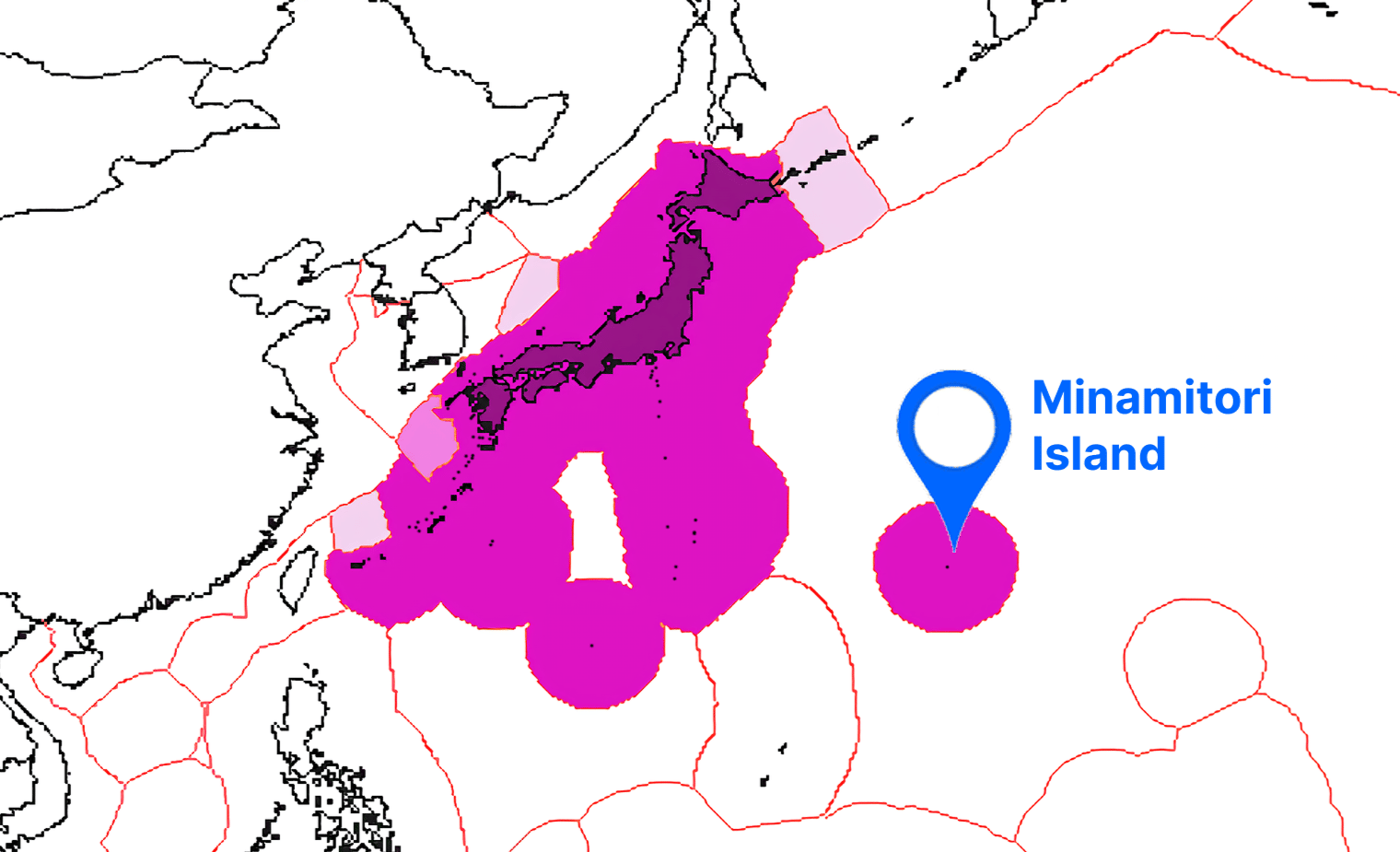
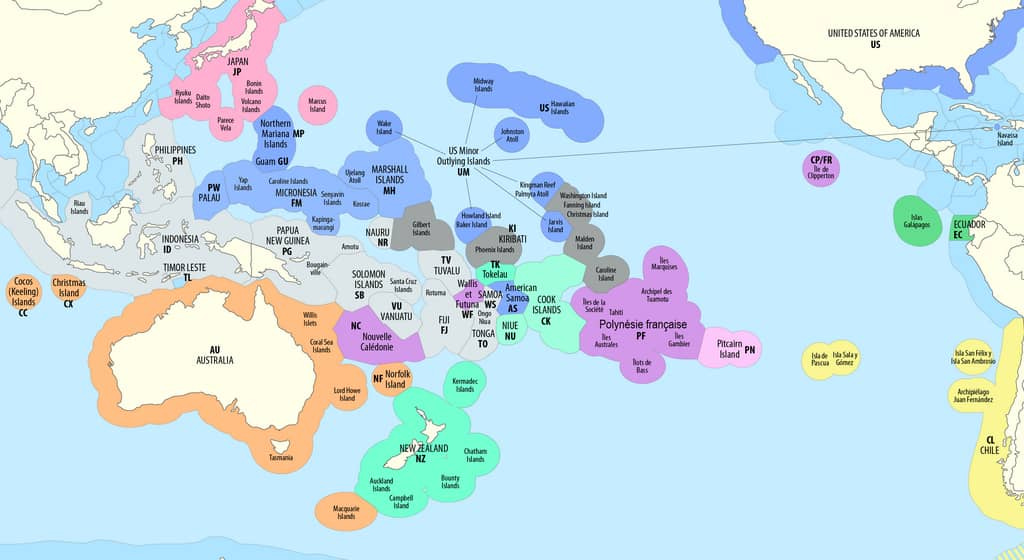
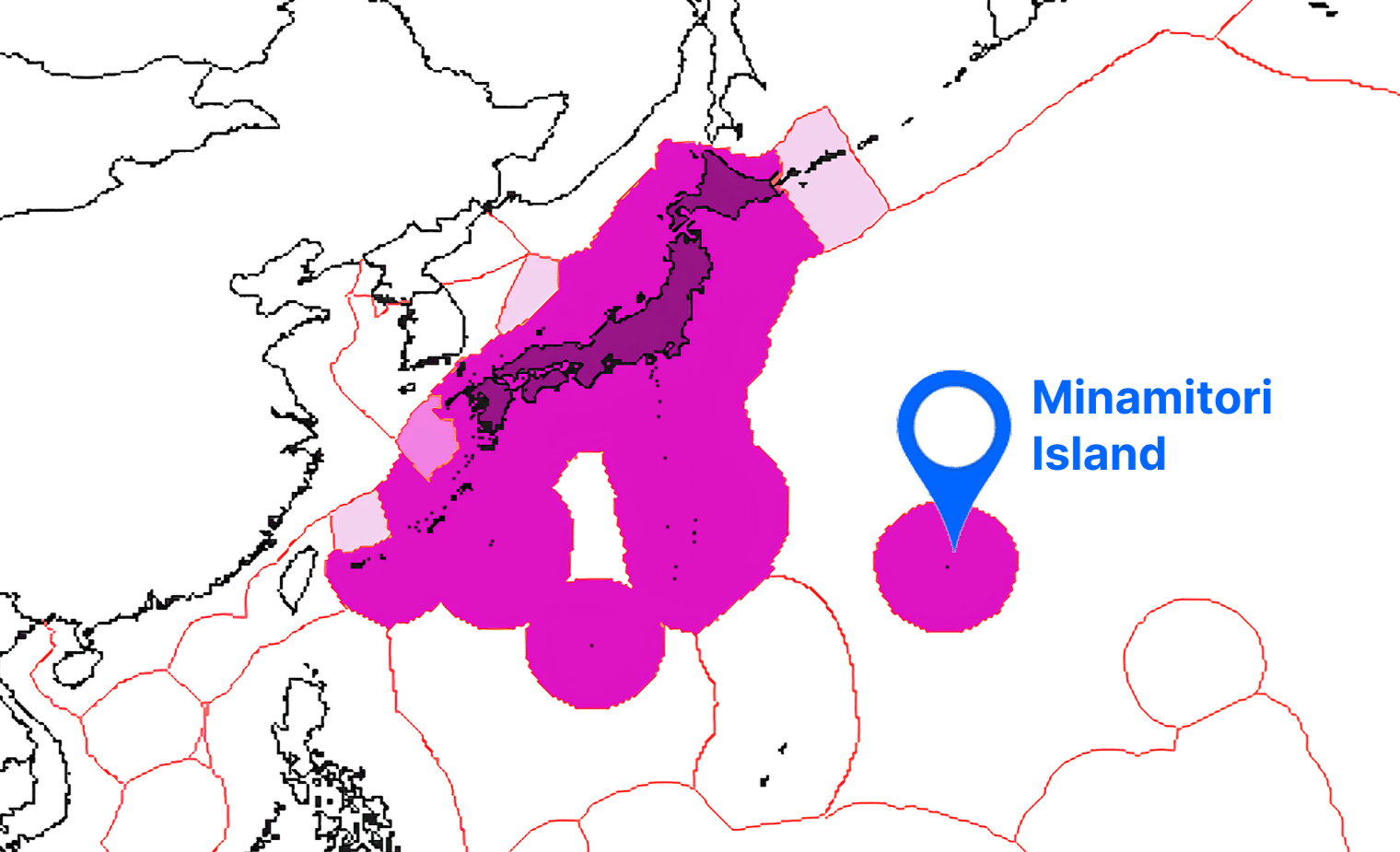
Japan’s recent test is happening near Minamitori Island (Marcus Island), roughly 1,900 km southeast of Tokyo, and inside Japan’s Exclusive Economic Zone (EEZ).
This difference in jurisdiction helps explain why Japan has been able to move ahead while many other efforts have remained stuck at the exploratory or regulatory stage.
Two quick implications here:
Japan can treat this like a national infrastructure project, not a legal/diplomatic negotiation.
The bottlenecks are technical and economic. Logistics are much tougher.
International waters are a different story
Under the UN Convention on the Law of the Sea, once you move beyond national EEZs, you enter “The Area”
The gatekeeper is the International Seabed Authority (ISA), whose explainer on exploration contracts gives a clean snapshot of how much of the ocean floor is already parceled into exploration areas.

Companies are trying to bypass the ISA
This is where things get really interesting.
The UN Convention on the Law of the Sea was ratified by more than 165 nations, but not the United States. And recently, companies have tried to establish a route around the ISA, through the USA.
Lost in the sea of Trump noise last year was this executive order, which directed the Secretary of Commerce to expedite the review and issuance of exploration and commercial recovery permits.
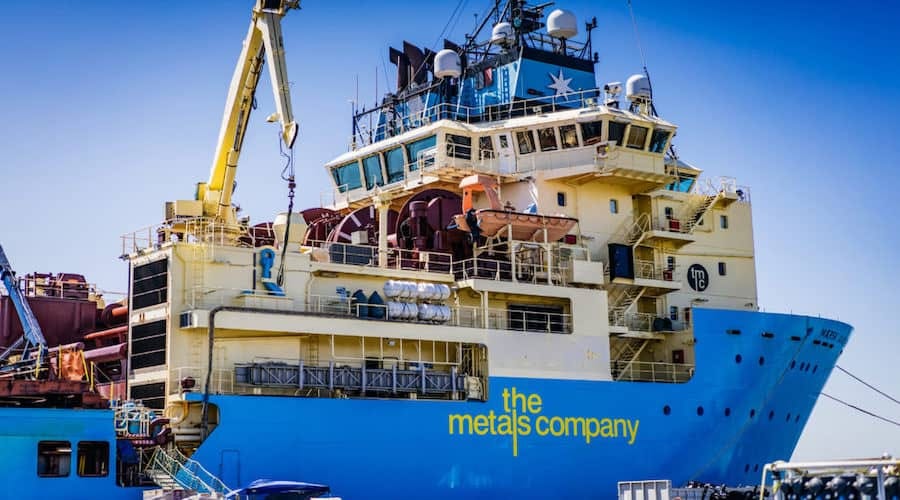
Less than a week after the order was issued, Canadian firm The Metals Company announced its intention to sidestep the ISA and seek permission from the US government to start deep-sea mining in international waters.
“With these applications, we are offering the United States a shovel-ready path to new and abundant supplies of nickel, copper, cobalt, and manganese — critical metals for energy, infrastructure and defense.”
— Gerard Barron, CEO of The Metals Company
This was a big deal. The ISA responded:
“Any commercial exploitation outside of national jurisdiction carried out without the authorization of ISA would constitute a violation of international law.”
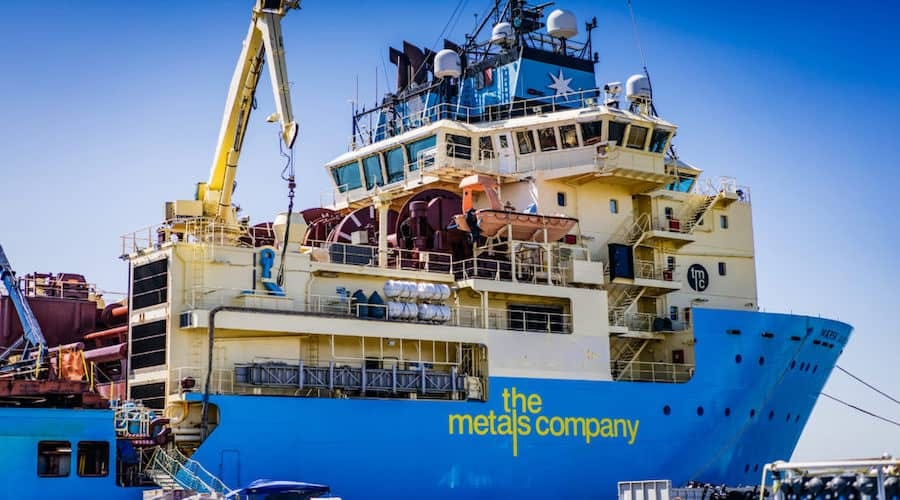
Part of the reason the ISA has dragged their heels on allowing mining in international waters is that member states have struggled to agree on a global royalty/taxation system, or how to resolve environmental harms, which are still poorly defined and managed.
Environmental considerations
Environmental risks are one of the biggest reasons deep sea mining has been slow to develop. The potential negative externalities are obvious and unresolved: physical disturbance of the seabed, sediment plumes, and impacts on ecosystems remain poorly understood.
Ironically, during the 1970 pilot expedition, researchers were as interested in the potential positive externalities as they were in extraction itself. The team was not solely focused on collecting nodules. In fact, member Christopher Garside bluntly stated they “couldn’t care less about it.”
Instead, they were interested in the idea that the artificial upwelling of deep-sea water could bring cold, dense water to the surface — potentially boosting the ocean’s productivity for human benefit!
As Garside explained:
“[The ocean] will be rich in nutrients, nitrogen, and phosphorus, which might generate plankton growth, which might provide food for fish. Suddenly, if this happens, you’ve got a fish farm and part of the answer to the shortage of food for humans.”
Fast-forward to today, and the deep ocean remains one of the least studied ecosystems on Earth. We know that mining disturbs the seabed directly and creates sediment plumes that can spread beyond the collection area. But researchers are still exploring how far those plumes travel, how long they persist, and what they mean for the recovery of slow-growth organisms.
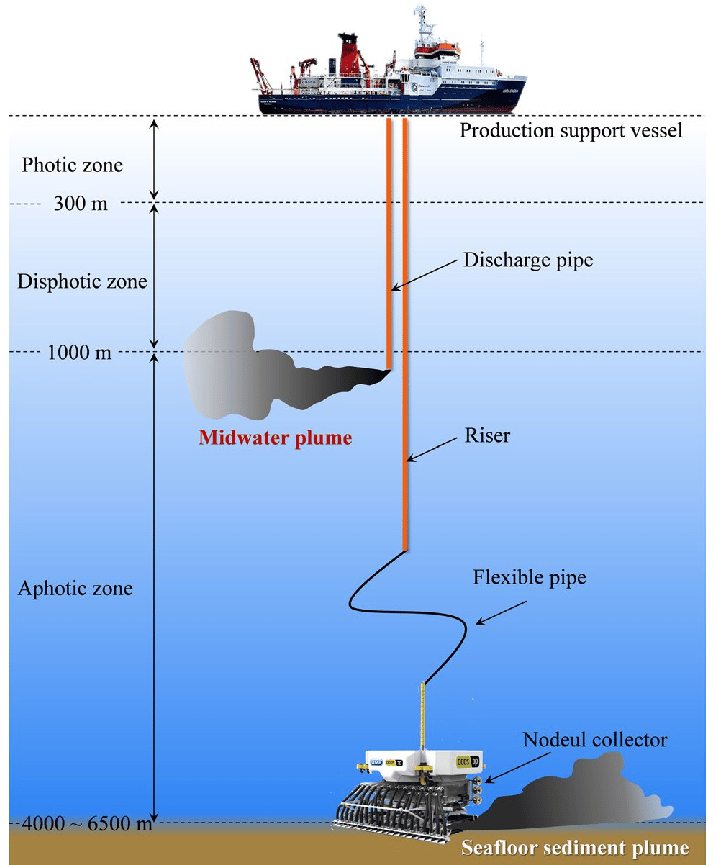
At the same time, deep sea mining differs meaningfully from land-based extraction. There’s no blasting, tailings slurry, or displacement of human communities. Avoiding familiar harms doesn’t automatically make new ones acceptable, but it does explain why some governments view controlled testing as distinct from full-scale industrial mining.
“Deep-sea mining has the potential to impact not just the seabed environment, but all of the life in between. There are so many mysteries about this part of the ocean where we’ve just been able to scratch the surface.”
— Jeff Watters, VP at US-based nonprofit Ocean Conservancy
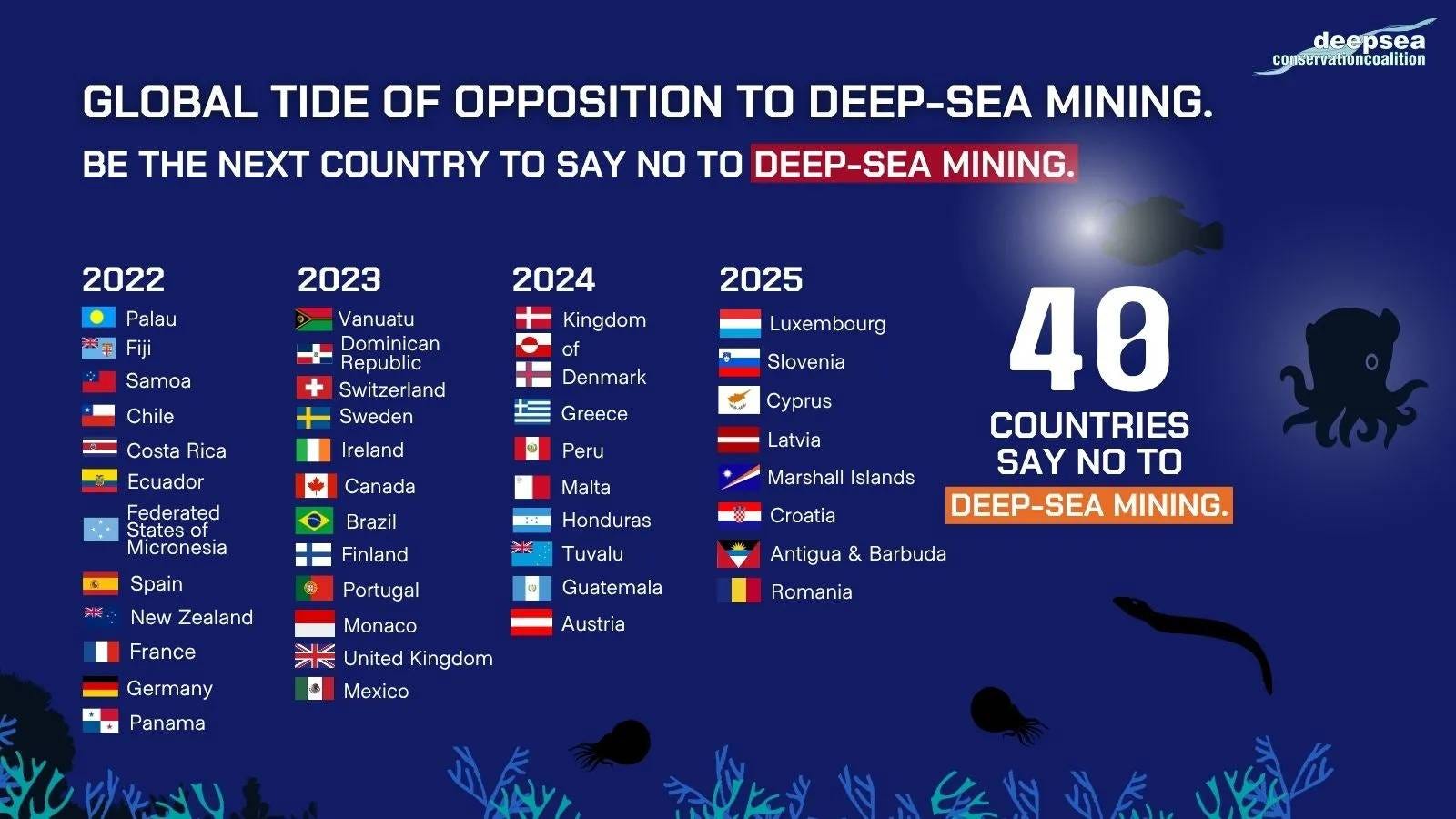
These unresolved mysteries have driven calls from scientists and governments for moratoriums on mining in international waters until more data is collected.
Others (like Japan) argue that limited, tightly regulated trials are the only way to generate that data in the first place.
Closing thoughts
It may have taken a while for deep sea mining to get mainstream attention, but there’s no chance it goes away anytime soon.
This world is resurfacing for a very important reason: The energy transition is accelerating, supply chains are getting politicized, and access to critical minerals is now treated as a matter of national security. Governments are unwilling to ignore what’s sitting on the ocean floor any longer.
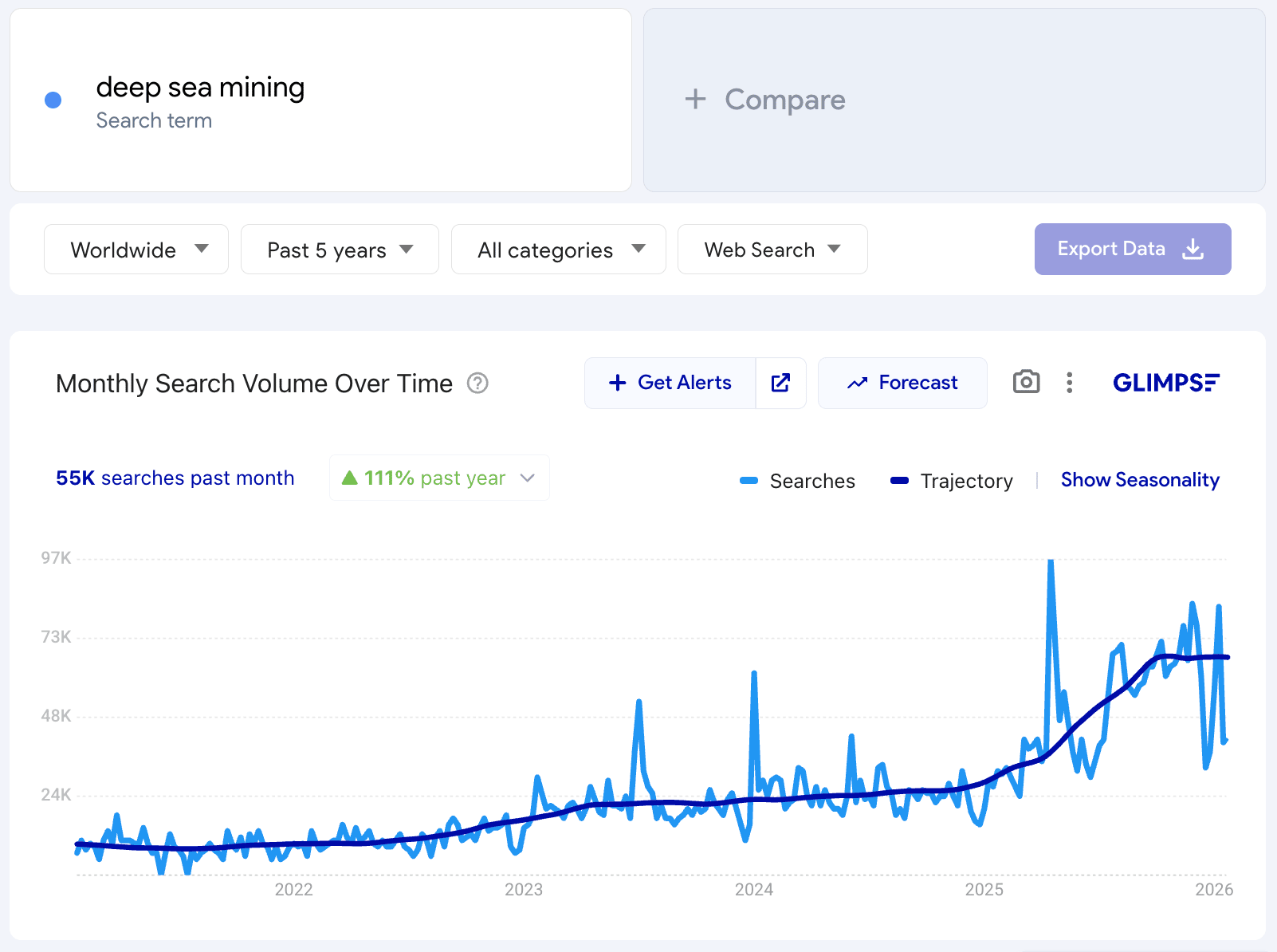
At the same time, the environmental issues aren’t going away. If anything, they’ve become more central. Regulators are right to be cautious about industrial activity in parts of the earth we barely understand.
For investors, that matters, because it means most large-scale seabed mining will likely remain slow and state-led for years. Private companies don’t have many lucrative EEZ opportunities, or paths to skirting the ISA bottlenecks in international waters.
Meanwhile, other parts of the underwater resource economy contain riches where assets are known, legal frameworks are clearer, and environmental impact is minimal.
Oceyon sits in that alternative lane. Their work focuses on recovery, not mining, using established maritime law and discrete, mission-based operations. It’s a very different risk profile. Express interest now.
As always, we’ll keep digging into the corners of the market most people ignore. Sometimes that means the future. And sometimes it means what’s been sitting underwater for decades. ⚓
---
That’s all for today!
Come discuss the Oceyon SPV in the Alts community.
See you there,
Stefan


Disclosures
This issue was written and edited by Stefan von Imhof
This issue was sponsored by Oceyon. It contains no affiliate links.
Alt Assets, Inc has no holdings in any companies mentioned in this issue. We are considering creating an SPV with Oceyon.
How we got here (a short history)
Deep sea mining feels new because the headlines are new. But the underlying idea is not.
The modern story starts in 1870s, when HMS Challenger dredging expeditions first recovered strange, metal-rich nodules from the deep ocean floor.
But it wasn’t until the 1960s that scientists began to understand what they were actually looking at. Advances in sonar and deep-sea sampling revealed that huge swaths of the seabed, particularly in the Pacific, were carpeted with potato-sized polymetallic nodules formed over millions of years.
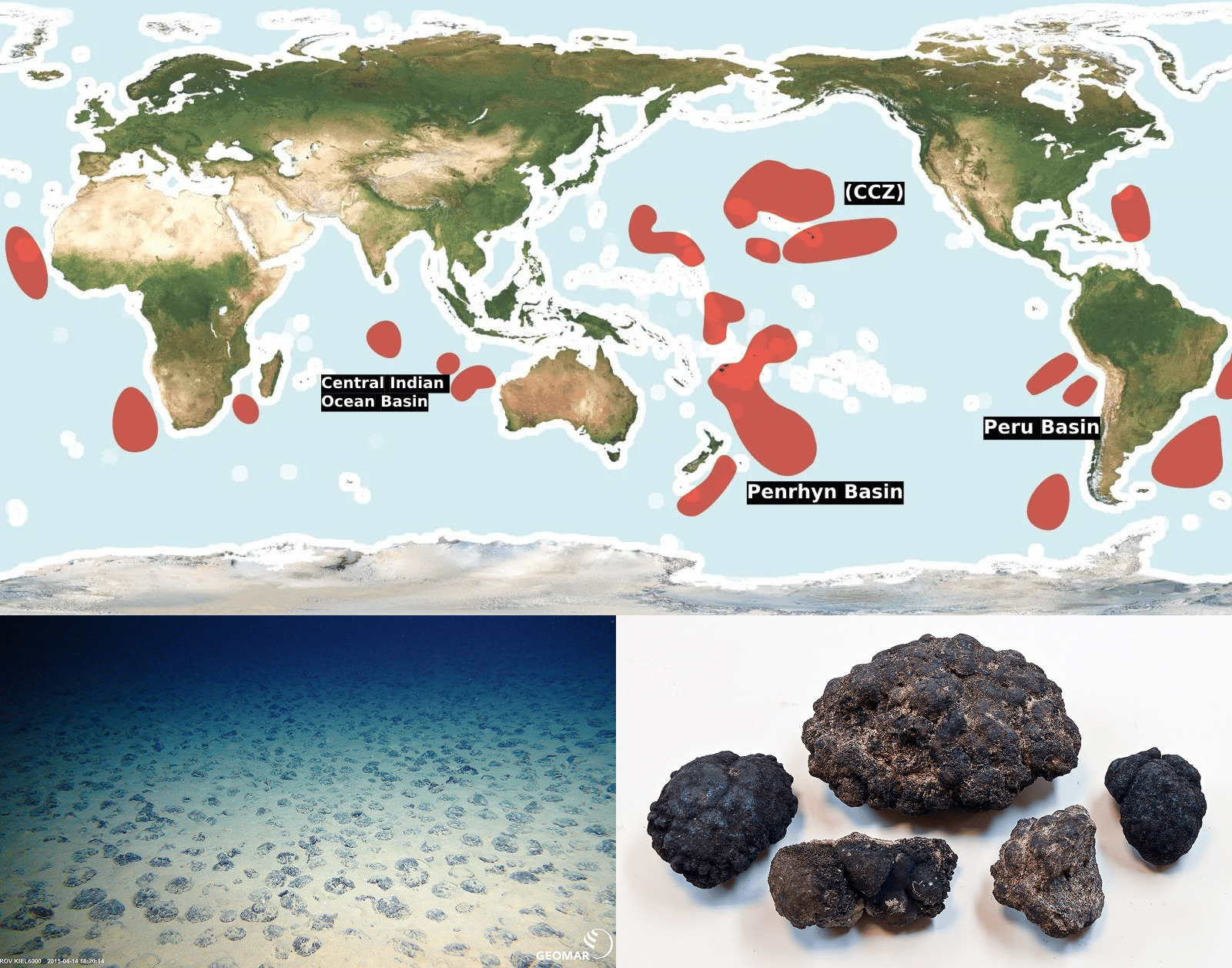
Once researchers realized how widespread these nodules were, interest moved quickly from science to economics. Throughout the 1970s, governments, oil majors, and mining companies spent hundreds of millions funding extraction trials.
In July 1970, Deepsea Ventures conducted the world’s first deep-sea mining test 300 km off the coast of South Carolina, marking the start of the “nodule rush.” They used a hydraulic suction dredge to collect manganese nodules, and a continuous lift system to get them to the surface.
Why the seafloor mining industry never scaled
The process worked. So why hasn’t seafloor mining turned into a bigger industry?
Well, a few practical realities got in the way.
The economics were brutal
Offshore operations were expensive, and profitability depended on long-term metal prices cooperating in very specific ways.
The engineering was unforgiving
Deep sea mining is conceptually simple but operationally hard. Operating reliably several kilometers underwater left little margin for error, and failures were costly.
Onshore supply was just easier
Deep sea mining only replaces the extraction step, refinement is still a huge cost. Land-based mining was cheaper, familiar, and already embedded in global supply chains.
Collecting nodules for a few days is one thing. Running equipment reliably for months, in deep water, far from shore, with predictable costs and throughput, is something else entirely.
The legal and political framework lagged
This last point is critical.
After the 1970 pilot tests, countries without the capital or technical capacity to pursue deep sea mining began pushing for an international legal regime that would govern access to the seabed, redistribute economic benefits, and require the sharing of mining technology.
Unsurprisingly, this push ran directly into resistance from industrialized nations & companies that had already invested heavily in exploration and equipment.
The result was prolonged disagreement over ownership, licensing, and authority in international waters. Those disputes dragged on just as metal prices weakened and technical challenges piled up.
By the early 1980s, the combination proved harmful. Without clear answers on who could mine, where, and under what rules, deep sea mining stalled before it could turn into a durable industry.
Who owns the ocean floor?
Before getting to Japan, we need to clarify one important point: there is no single legal regime governing the entire ocean floor.
There are two distinct jurisdictions:
Inside a country’s exclusive economic zone (EEZ), where national laws and regulators apply.
In international waters, where the rulebook is global, slow-moving, and still unfinished
Japan is testing in its own waters
Japan’s recent test is happening near Minamitori Island (Marcus Island), roughly 1,900 km southeast of Tokyo, and inside Japan’s Exclusive Economic Zone (EEZ).
This difference in jurisdiction helps explain why Japan has been able to move ahead while many other efforts have remained stuck at the exploratory or regulatory stage.
Two quick implications here:
Japan can treat this like a national infrastructure project, not a legal/diplomatic negotiation.
The bottlenecks are technical and economic. Logistics are much tougher.
International waters are a different story
Under the UN Convention on the Law of the Sea, once you move beyond national EEZs, you enter “The Area”
The gatekeeper is the International Seabed Authority (ISA), whose explainer on exploration contracts gives a clean snapshot of how much of the ocean floor is already parceled into exploration areas.

Companies are trying to bypass the ISA
This is where things get really interesting.
The UN Convention on the Law of the Sea was ratified by more than 165 nations, but not the United States. And recently, companies have tried to establish a route around the ISA, through the USA.
Lost in the sea of Trump noise last year was this executive order, which directed the Secretary of Commerce to expedite the review and issuance of exploration and commercial recovery permits.
Less than a week after the order was issued, Canadian firm The Metals Company announced its intention to sidestep the ISA and seek permission from the US government to start deep-sea mining in international waters.
“With these applications, we are offering the United States a shovel-ready path to new and abundant supplies of nickel, copper, cobalt, and manganese — critical metals for energy, infrastructure and defense.” — Gerard Barron, CEO of The Metals Company
This was a big deal. The ISA responded:
“Any commercial exploitation outside of national jurisdiction carried out without the authorization of ISA would constitute a violation of international law.”
Part of the reason the ISA has dragged their heels on allowing mining in international waters is that member states have struggled to agree on a global royalty/taxation system, or how to resolve environmental harms, which are still poorly defined and managed.
Environmental considerations
Environmental risks are one of the biggest reasons deep sea mining has been slow to develop. The potential negative externalities are obvious and unresolved: physical disturbance of the seabed, sediment plumes, and impacts on ecosystems remain poorly understood.
Ironically, during the 1970 pilot expedition, researchers were as interested in the potential positive externalities as they were in extraction itself. The team was not solely focused on collecting nodules. In fact, member Christopher Garside bluntly stated they “couldn’t care less about it.”
Instead, they were interested in the idea that the artificial upwelling of deep-sea water could bring cold, dense water to the surface — potentially boosting the ocean’s productivity for human benefit!
As Garside explained:
“[The ocean] will be rich in nutrients, nitrogen, and phosphorus, which might generate plankton growth, which might provide food for fish. Suddenly, if this happens, you’ve got a fish farm and part of the answer to the shortage of food for humans.”
Fast-forward to today, and the deep ocean remains one of the least studied ecosystems on Earth. We know that mining disturbs the seabed directly and creates sediment plumes that can spread beyond the collection area. But researchers are still exploring how far those plumes travel, how long they persist, and what they mean for the recovery of slow-growth organisms.
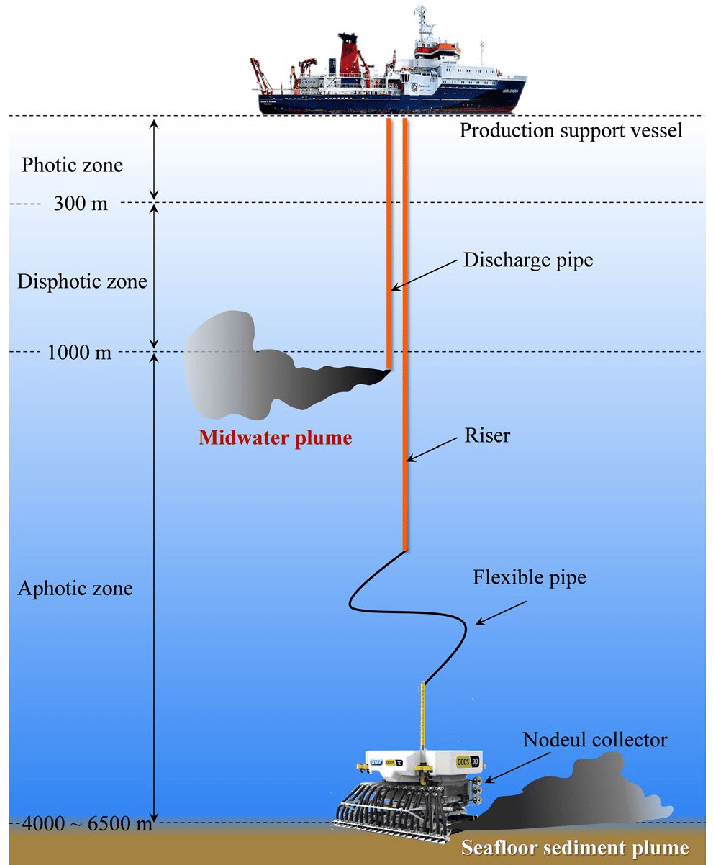
At the same time, deep sea mining differs meaningfully from land-based extraction. There’s no blasting, tailings slurry, or displacement of human communities. Avoiding familiar harms doesn’t automatically make new ones acceptable, but it does explain why some governments view controlled testing as distinct from full-scale industrial mining.
“Deep-sea mining has the potential to impact not just the seabed environment, but all of the life in between. There are so many mysteries about this part of the ocean where we’ve just been able to scratch the surface.” — Jeff Watters, VP at US-based nonprofit Ocean Conservancy
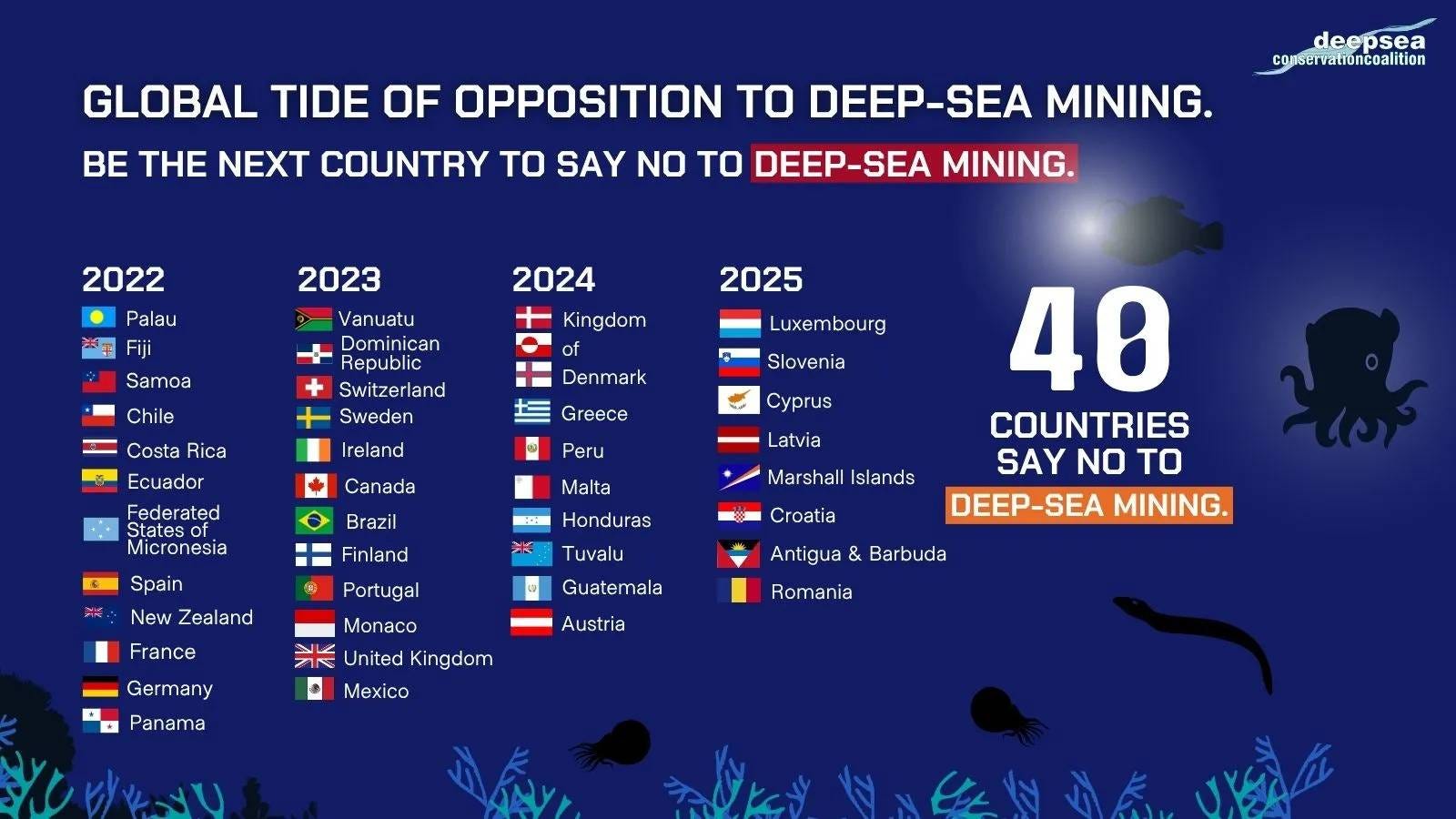
These unresolved mysteries have driven calls from scientists and governments for moratoriums on mining in international waters until more data is collected.
Others (like Japan) argue that limited, tightly regulated trials are the only way to generate that data in the first place.
Closing thoughts
It may have taken a while for deep sea mining to get mainstream attention, but there’s no chance it goes away anytime soon.
This world is resurfacing for a very important reason: The energy transition is accelerating, supply chains are getting politicized, and access to critical minerals is now treated as a matter of national security. Governments are unwilling to ignore what’s sitting on the ocean floor any longer.
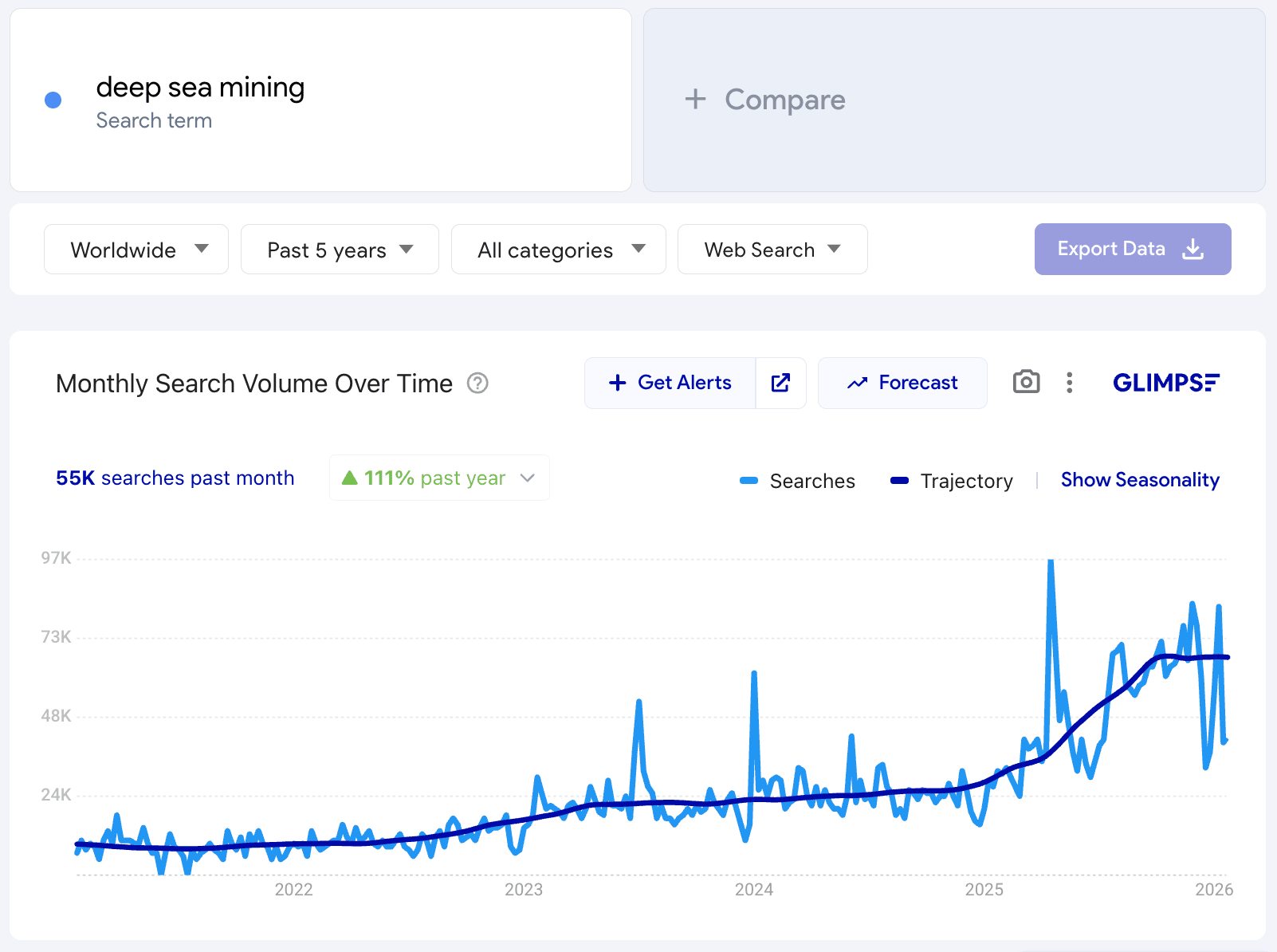
At the same time, the environmental issues aren’t going away. If anything, they’ve become more central. Regulators are right to be cautious about industrial activity in parts of the earth we barely understand.
For investors, that matters, because it means most large-scale seabed mining will likely remain slow and state-led for years. Private companies don’t have many lucrative EEZ opportunities, or paths to skirting the ISA bottlenecks in international waters.
Meanwhile, other parts of the underwater resource economy contain riches where assets are known, legal frameworks are clearer, and environmental impact is minimal.
Oceyon sits in that alternative lane. Their work focuses on recovery, not mining, using established maritime law and discrete, mission-based operations. It’s a very different risk profile. Express interest now.
As always, we’ll keep digging into the corners of the market most people ignore. Sometimes that means the future. And sometimes it means what’s been sitting underwater for decades.
That’s all for today!
Come discuss the Oceyon SPV in the Alts community.
See you there,
Stefan