

Gold leasing explained

Most gold just sits idle. Monetary Metals connects it to industry demand, offering a unique way to earn yield.
Most investments are tied to productive activity. For example, stocks help finance business growth, and real estate gives people places to live.
Historically, gold has been an exception to this. The shiny metal would sit in a vault, storing its value – but not actually doing anything.

But thanks to Monetary Metals, gold’s reputation as a dormant asset is changing.
Monetary Metals offers a way for investors to put their gold to real-world, productive use – and generate yield in the process.
The company achieves that through its innovative gold leasing model. As we’ll see, businesses value these leases as a cost-effective form of inventory financing and risk management.
In this issue, we’re looking at Monetary Metals and the concept of gold as a yield-generating, productive asset. Along the way, we’ll explore:
Why tangible assets are typically negative carry, impairing investor returns,
How linking investment and industry creates opportunities to earn yield,
How Monetary Metals offered their first gold lease in 2016,
And how the firm’s model can transform gold into an asset with compound growth potential – in addition to price appreciation.
Once you understand how gold leases work, the argument for financing them is straightforward and compelling.
If you have any gold exposure in your portfolio – or you’re interested in building some – this piece is absolutely worth reading.
Let’s go
How negative carry hurts returns
Generally speaking, there are two distinct types of investments:
Financial assets exist only on paper – think stocks and bonds.
Tangible assets exist in the material world – think oil, metals, and property.
Because financial assets only exist on paper, they cost almost nothing to maintain or trade. But that’s not true for tangible assets.
These assets can be expensive to store and move. Oil, for instance, requires tightly secured barrels and massive tanker ships.


These ongoing costs can eat into returns over time – a concept known in finance as negative carry.
Many investors underappreciate the detrimental impact that negative carry can have on returns. That’s especially true when it comes to gold.
The high costs of storing gold
Gold is one of the OG alternative assets. Globally, investors are estimated to hold around $35 trillion worth of the metal.
Storing all that gold doesn’t come cheap:
Costs of storing gold include secured vaults, custody fees, and insurance. Monetary Metals estimates that these costs add up to about $150 billion in annual fees for investors.
The exact costs vary depending on how you access the market, but average roughly 0.50% of value annually (the world’s most-popular gold ETF has an expense ratio of 0.40%).
These explicit costs don’t capture the opportunity cost of holding gold. Investing in gold means you can’t earn money market rates, which currently average around 3.6%.
The bottom line? Because gold is a traditionally negative carry asset, price appreciation needs to outpace these costs for investors to generate wealth.
For years, the concept of transforming gold into a positive carry asset remained theoretical – nobody could quite figure out how to make it work.
But that changed when Monetary Metals introduced the company’s gold leasing model.
What is Monetary Metals?
Monetary Metals was formed to help investors earn a yield on their precious metals holdings.
The company primarily focuses on gold, working to turn the asset from something that costs money into one that generates it.

Monetary Metals is the brainchild of founder and CEO Keith Weiner, who formed the company in 2012.
Keith’s key insight is that an asset can only earn a positive yield if it’s actively being used – for instance, nobody would lease a car just to have it sit in the driveway.
And while investors often think of gold as a dormant asset, there are real-world businesses that use this metal every single day.
Industry accounts for ~40% of gold demand
Last year, global gold demand exceeded 5,000 tonnes for the first time. Investment and central bank purchases made up the majority of those purchases, at about 61%.
But that still leaves significant demand coming from productive sources:
Jewelry fabrication is the largest alternative source of gold demand, accounting for about a third of gold purchases in 2025.
Technology and electronics also contributed roughly 6%, where the metal is used to create chips and circuits.

.jpg)
These productive uses indicate that gold has the potential for positive yield generation.
And Monetary Metals’ gold leasing model is the link that connects gold investing with the gold industry.
Gold leasing = investment + industry
Gold leasing works similarly to many other forms of property leasing. Investors who have gold offer it to businesses that need gold – in exchange for regular rental payments.
To understand why a firm might need to lease gold, imagine that you’re a jewelry manufacturer who specializes in creating intricately designed gold jewelry.
Consider the economics of a standard transaction:
First, you need to acquire the raw material to make a new piece. Suppose you’re attempting to make a 1oz piece, and gold is currently trading for $4,500/oz.
After working for weeks to refine the piece, you decide that it’s ready to sell. You plan to charge a $1,000 premium for your skill, craft, and effort.
But here’s the problem: by the time you go to sell the piece, the gold market has slipped, with prices dropping to $4,000/oz. As a result, you can only sell the piece for $5,000.
You originally planned to spend $4,500 to make $5,500. But the market decline cut your expected profit in half.
Without some type of risk management, many gold-based businesses inadvertently turn into gold speculators.
Rather than generate profits purely from their value-add, they make (or lose) money based on gold market volatility.

This is where gold leases can add value, providing an efficient way for firms to manage gold price risk – ensuring that they make money based on their skill, not speculation.
How does gold leasing work?
Ultimately, gold price risk comes down to a timing issue. There’s a gap between when firms buy gold and when they sell it, with prices fluctuating in between.
A leasing structure avoids that risk entirely by allowing firms to buy and sell gold at the exact same time.
Returning to our previous example, here’s how things would work with a gold lease:
As the jeweler, you lease 1oz of gold from an investor. No money changes hands at this time.
Just as before, you use the gold to craft a beautiful jewelry piece, aiming to earn a $1,000 profit.
Gold is trading at $4,000/oz when you go to sell the piece, resulting in the same $5,000 pricing. A customer quickly purchases the jewelry.
Under the terms of the lease, you’re obligated to replace any leased gold that goes out the door. Therefore, you go into the open market and purchase 1oz of gold for $4,000.
Under the leasing model, you earn the exact $1,000 premium that you expected – not half that amount.
It doesn’t matter that prices fell between Step 1 and Step 4. You were able to guarantee your purchase price at the same time as you guaranteed your sale price.
A small lease rental fee is taken from the profit of each transaction to pay the lessor their lease yield. However, this is usually a small price to pay for the security of knowing exactly how much you’ll earn.
Gold leasing in practice: How Monetary Metals works
We’ve seen how gold leasing works in theory. But in practice, investor success depends on how exactly these leases are implemented.
Below, we’ll take a closer look at how Monetary Metals works, focusing on three key elements of the firm’s leasing structure.
#1: Disciplined legal structuring
Monetary Metals operates by the Hippocratic Oath for Gold – above all else, the firm strives to lose no gold.
Leasing property is not risk-free. Gold can be lost in transport, stolen by a fraudulent lessee, or confiscated by a government.
Monetary Metals uses disciplined legal structuring to minimize these risks:
Title – The title of the gold remains with the lessor at all times, meaning that legal ownership never transfers to the lessee. This is a key difference between a ‘true lease’ and a loan.
Replacement Obligation – Lessors are required to immediately replace all gold that goes out the door. The total gold that they hold can never fall below 110% of the leased amount.
Insurance – Monetary Metals maintains insurance as the named party on all leased gold. Should something go wrong, they can file an insurance claim for the value of the metal.
While it’s impossible to eliminate downside entirely, this structuring helps minimize the risks associated with theft or bankruptcy.
#2: Gold yield payments
One of the most unique elements of Monetary Metal’s model is that the lease yield is paid in additional gold, not dollars.
Because the lease is denominated in weight, companies rent ounces and repay ounces.


The fact that yield payments are made in gold offers specific benefits to both investors and firms:
For investors, earning gold-on-gold turns the metal into a compound growth asset. Regardless of price fluctuations, investors can steadily expand the overall volume of their gold portfolio.
For firms, this structure avoids gold price risk and the need to tie up capital in inventory. Companies that have significant gold assets but dollar-based price risk can face stress if the price of gold drops.
Metal-on-metal financing creates a ‘closed loop’ of gold, minimizing conversion risk on both sides of the deal.
#3: Thorough business vetting
Monetary Metals thoroughly vets every business that wants to take out a lease. That includes both understanding the business logic behind the lease, as well as analyzing the health of the firm itself:
In addition to jewelers, businesses that might seek to take out a gold lease include refiners, mints, and precious metals dealers.
Any lessee must have strong physical security and internal controls, as well as healthy corporate financial ratios.
Monetary Metals approves only a small fraction of deals that pass through the firm’s nine-step due diligence process. The company has successfully funded over 70 lease transactions.
While investors still need to perform their own due diligence, this approach means that Monetary Metals is not an open marketplace. Deals are vetted thoroughly before clients ever see them.
Investing with Monetary Metals
For interested investors, Monetary Metals has multiple gold leases currently live on the platform.
Here’s how the process works:
Account Creation. Monetary Metals manages all deals through the firm’s online dashboard. This platform allows investors to analyze deals, track their holdings, and handle transfers and withdrawals.
Metal Transfer. After creating an account, the next step is for investors to transfer their metal to the firm. Monetary Metals will cover shipping + insurance costs for metals from a residential US address, and also accepts transfer from professional vaults. You can also buy gold directly through the platform at a small premium over spot.
Evaluate and Commit to Leases. By default, Monetary Metals clients participate in every new deal that’s accepted to the platform. However, you can opt out of any lease that you’re not interested in funding.
Further details:
The minimum amount of gold needed to open an account is 10 ounces. Investors can also fund their account in cash with a $30,000 minimum.
While individual terms differ, investors typically earn a yield between 3-4% on their gold holdings with a 12-month maturity. Monetary Metals reports a weighted average return of 3.91% on all active gold leases.
Monetary Metals also offers other investment options. These include gold bonds (which feature higher yields) and silver investments (including leases and bonds).
Gold bonds are only available for accredited investors. Currently, Monetary Metals has no active bond offerings.
And while the company does accept silver investments, the majority of opportunities right now remain for gold investors.
Closing thoughts: Who is Monetary Metals right for?
Here’s the thing about Monetary Metals: if you’re not investing in gold already, the opportunity to fund gold leases is unlikely to tip the scales.
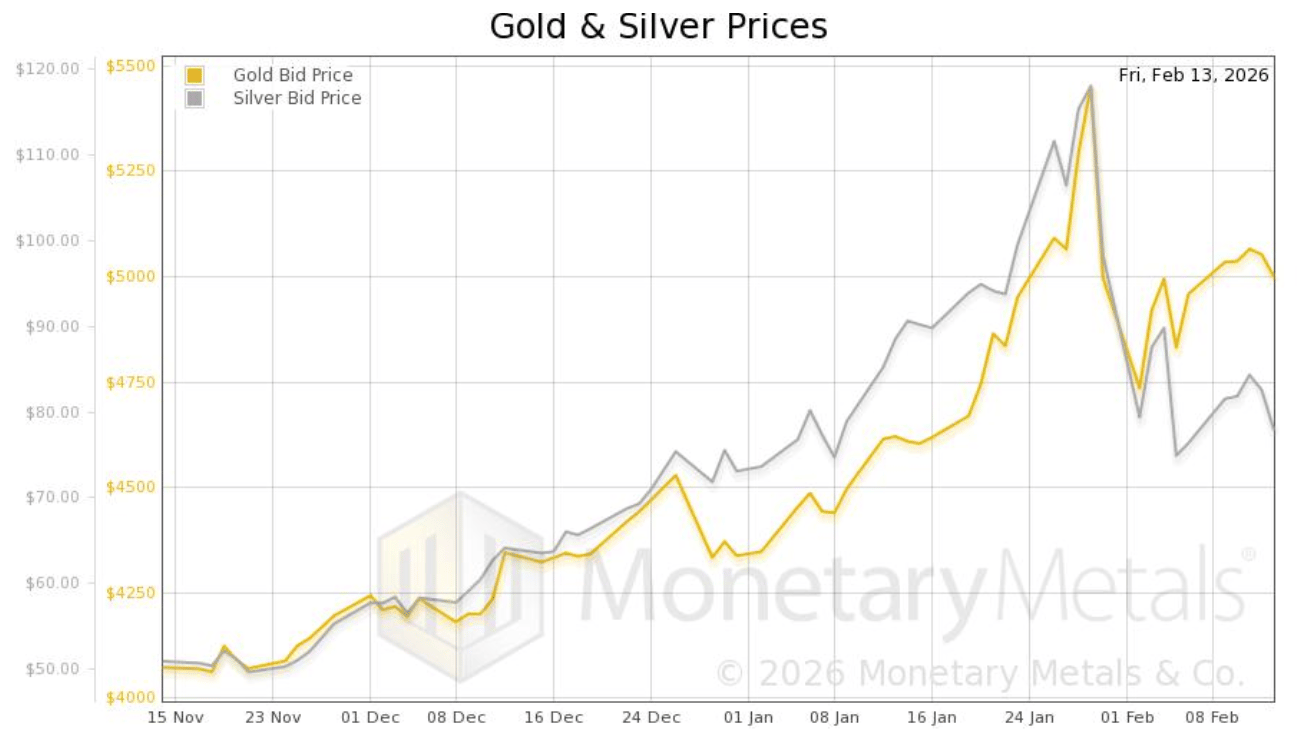
Earning an additional ~4% yield annually is definitely beneficial and allows investors to compound their gold positions over time. But if recent market fluctuations are any indication, gold price volatility is likely to be the core driver of future returns.
Moreover, if you’re physically holding gold as doomsday prep, shipping it off to a third party is unlikely to be appealing.
Instead, Monetary Metals could be right for a specific type of investor:
One who’s already investing in gold…
Who plans to hold long-term positions as a source of portfolio diversification…
And is willing to trade the absolute safety of a vault for the calculated risk of a lease.
For this type of investor, Monetary Metals could unlock decades of compounding that would otherwise be out of reach.
Transforming gold into a positive carry asset doesn’t eliminate the fundamental risks of investing in gold.
But Monetary Metals is proof that the days of treating gold like an asset that inherently costs money – rather than earns it – are over.
---
That’s it for today.
As always you can find me in the Alts community.
Until next time
Brian

Disclosures
This issue was written by Brian Flaherty, and edited by Stefan von Imhof
Monetary Metals was able to review an early draft of this article. Brian and Stefan made final editorial decisions.
This issue is a sponsored deep dive, meaning Alts has been paid to write an independent analysis of Monetary Metals. Monetary Metals has agreed to offer a deep look at its business, offerings, and operations. Monetary Metals is also a sponsor of Alts, but our research is neutral and unbiased. This should not be considered financial, legal, tax, or investment advice, but rather an independent analysis to help readers make their own investment decisions. All opinions expressed here are ours, and ours alone. We hope you find it informative and fair.