

Let’s break down the Besties

Welcome to the WC.
I’m at AFM this week in support of our Film I and Launch JV investments, so today you get to read a sort of evergreen post in the WC.
It was inspired by a chat I had with Stefan while in Mexico a couple weeks ago.
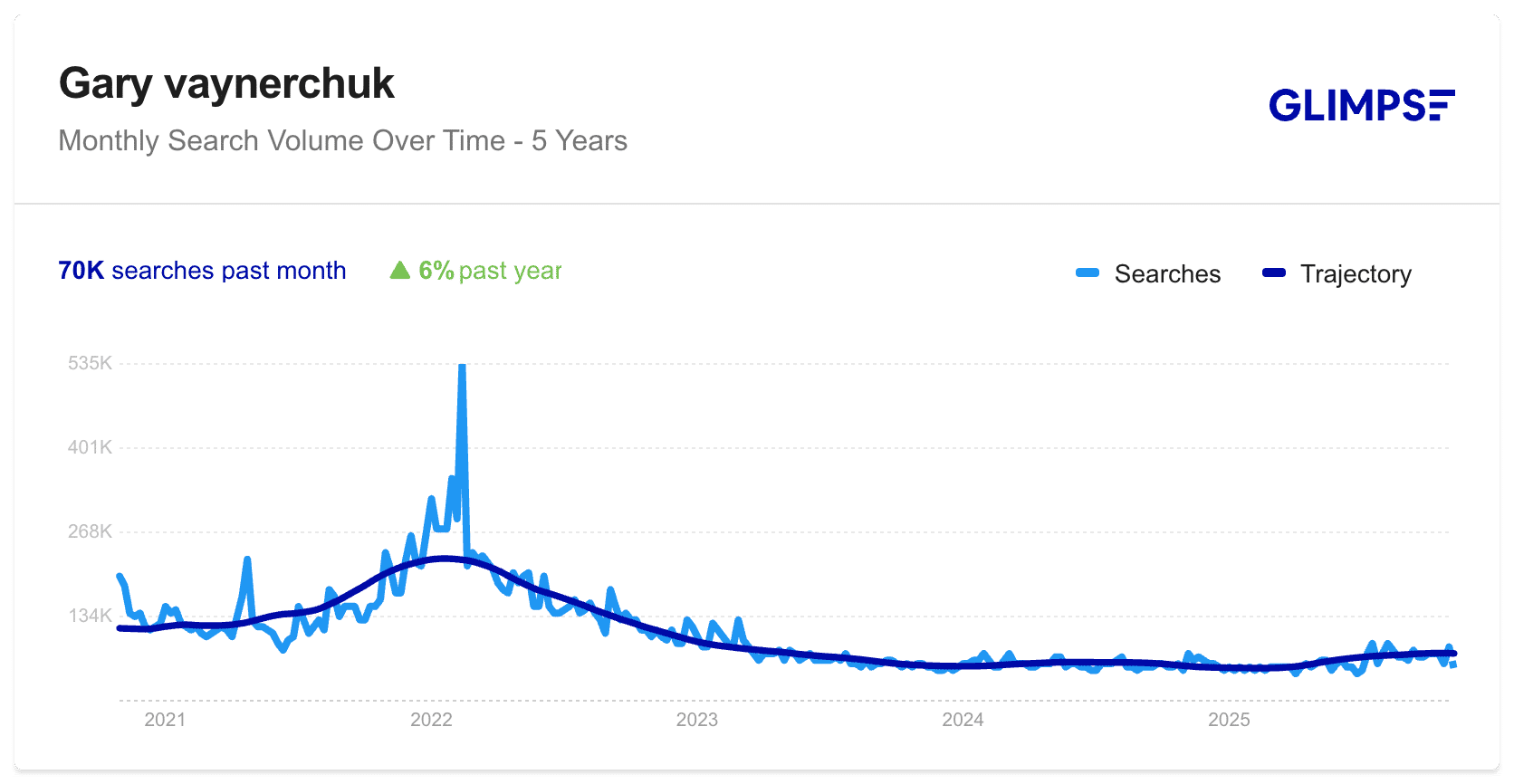
Basically, “Remember that Grifter Gary Vee? The guy who made NFTs and sold them to his audience and got rich and they lost all their money? Whatever happened to him?”
The answer to that ended up being quite boring. He’s still rich, they’re still poor, and he’s basically disappeared from the public consciences.
But you know who hasn’t had the dignity to go away quietly after disgracing themselves?
The dickbags from the All-In Podcast.
So let’s dig into their cult, the grift, and how and why they’re awful.
Table of Contents
The All-In Grift

It’s the four-man hype machine behind the All-In Podcast, where venture capital meets uninterrupted monologues about how smart they are. Think of it like Silicon Valley’s answer to a boy band, if the music was just talking over each other about how regulations are bad and you’re stupid for not buying Bitcoin in 2015.
The quartet (Chamath Palihapitiya, Jason Calacanis, David O. Sacks, and David Friedberg) are known for their hot takes, psychopathic lack of empathy, and an impressive ability to monetize a cult following while simultaneously underperforming the Nasdaq-100.
Here’s what they won’t tell you at their $7,500-per-ticket summits: If you’d followed their investment advice over the past five years, you would have earned an 11.2% annualized return while taking on significantly more risk than simply buying QQQ (which returned 16.8%), gold, the Mag 7, or, probably, a three gallon bucket of fetid effluent.
Strip out three consensus tech bets anyone could have made — Bitcoin, Tesla, and Robinhood — and their hand-picked investments lost an average of 42%.
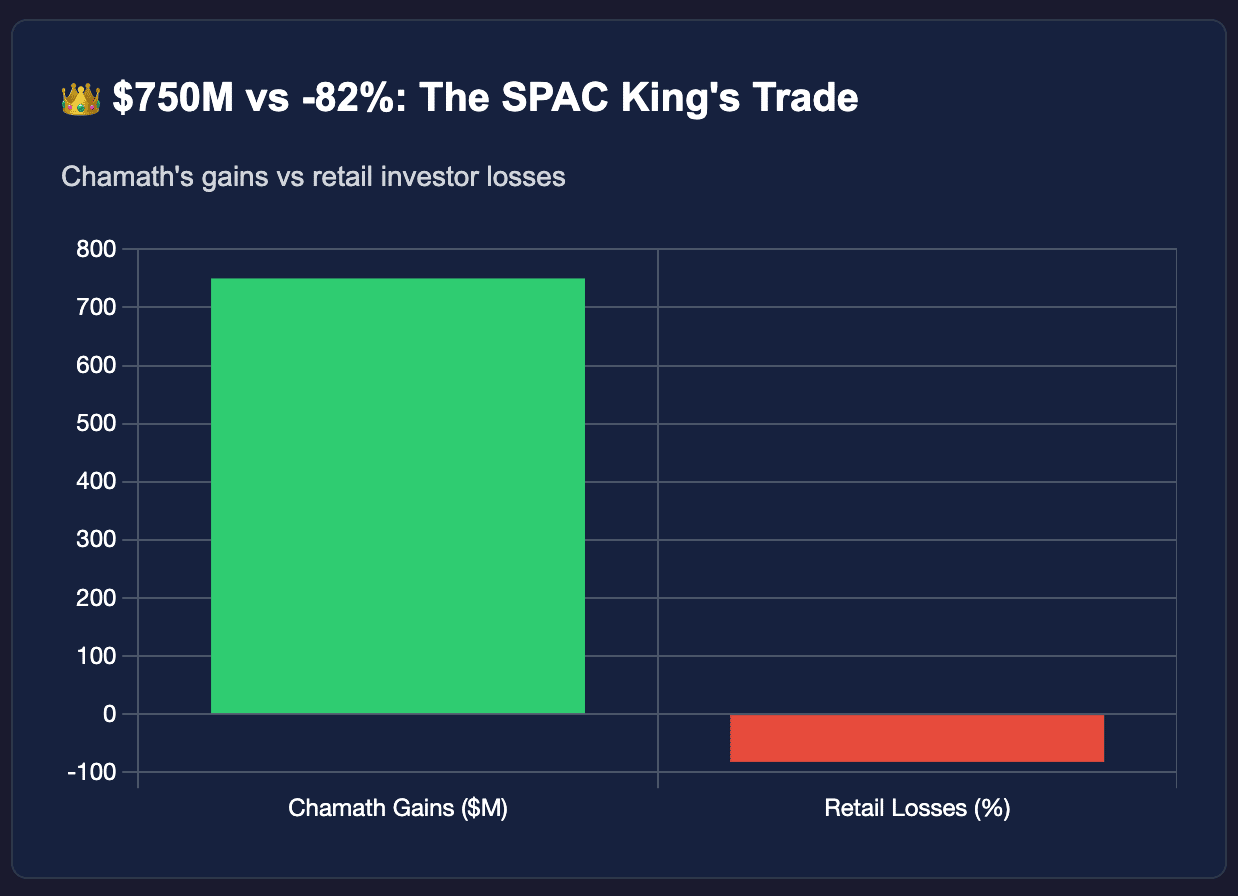
But they personally cleared tens of millions of dollars. Chamath alone reportedly made $750 million from SPAC exits while his retail followers lost an average of 82% on those same vehicles.
So how do they do it and what does it all mean?
Keep reading. 👇
How the All-In podcast makes money
The All-In Podcast famously has no traditional advertisements. The hosts often joke that they do it “for the love,” not money.
This is, of course, complete horseshit.
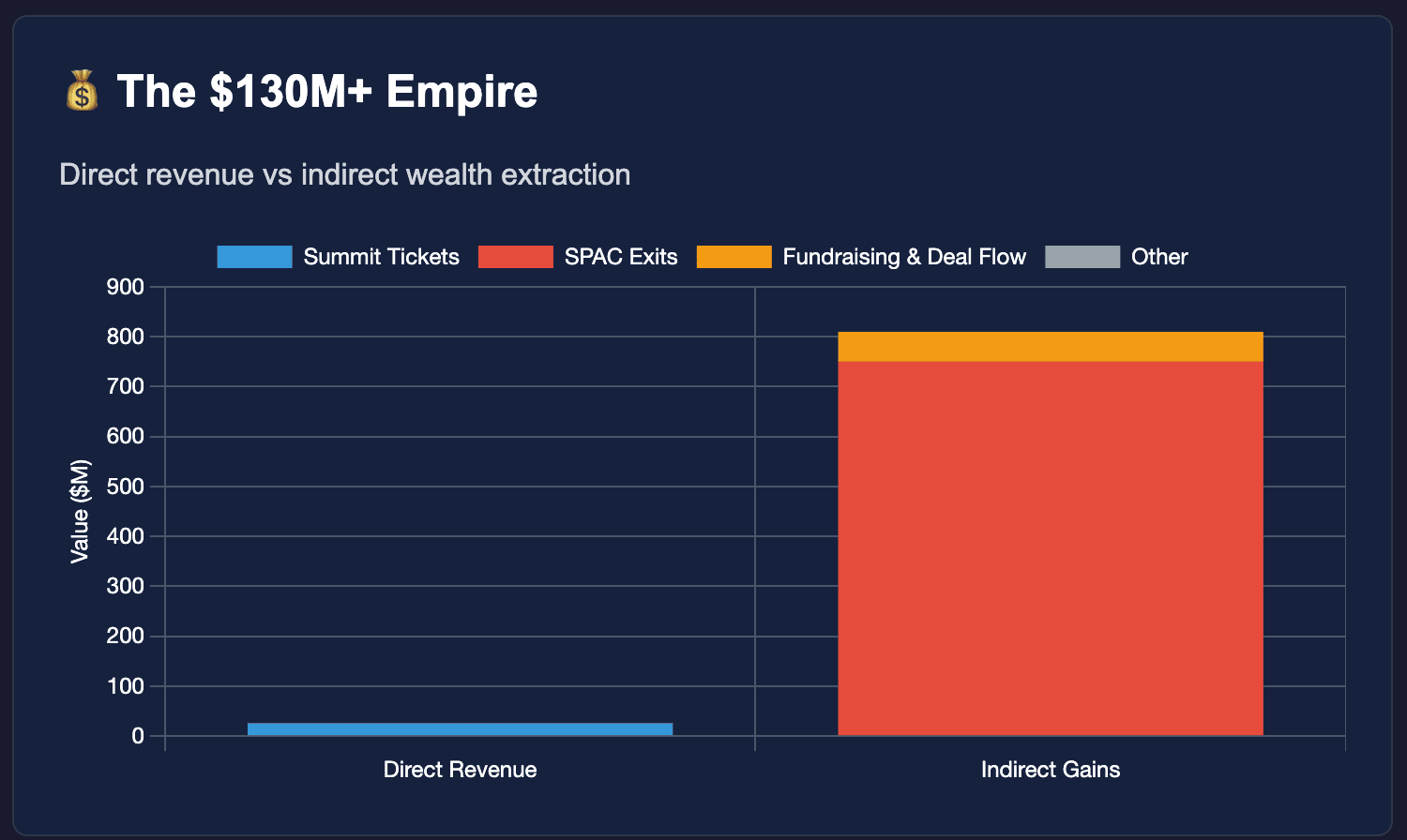
Between 2020 and 2025, the All-In brand generated an estimated $20-30 million in direct revenue — mostly from overpriced conferences.
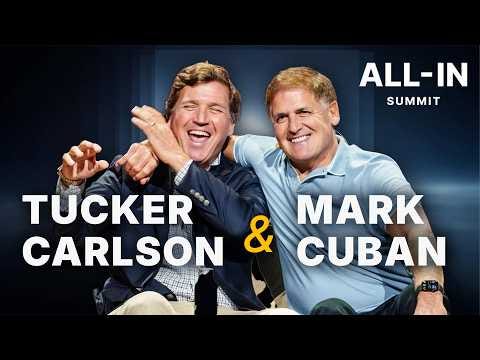
The All-In Summit is the physical manifestation of the podcast’s business model. It’s not really a conference, it’s a $7,500 ticket to an aspirational lifestyle where you get to breathe the same air as people who are richer than you.
The 2024 Los Angeles summit drew approximately 1,950 attendees at $7,500 each, generating $14.6 million in gross ticket revenue for a single weekend. That’s more than most venture-backed startups raise in a Series A, and all the Besties had to do was rent out a venue and invite their friends.
What do you get for $7,500?
According to North Ridge Partners, an investment advisory firm that attended, you get to watch the hosts “openly talk about how the podcast’s huge following has lifted their profiles and their businesses.” You get open bars, gourmet meals, and a night where they rented out Universal Studios. You get to network with other people who paid $7,500 to network with you.
One attendee’s observation perfectly captures the transaction: “By the end, we, the $7,500 attendees, were the product. And none of us cared.”
This is the genius of the model. The hosts aren’t selling knowledge or access to themselves — they’re selling access to each other’s audience. The Summit is a marketplace where founders pitch to VCs, VCs pitch to LPs, and everyone pays the Besties for the privilege of being in the room.
With summits in 2022, 2023, 2024, and 2025 all priced in the $7,000+ range, cumulative gross revenue from these events alone is plausibly $20-30 million.
But the $30 million in direct revenue is a rounding error compared to what the podcast generates for the hosts’ actual businesses.
Chamath’s SPAC Empire
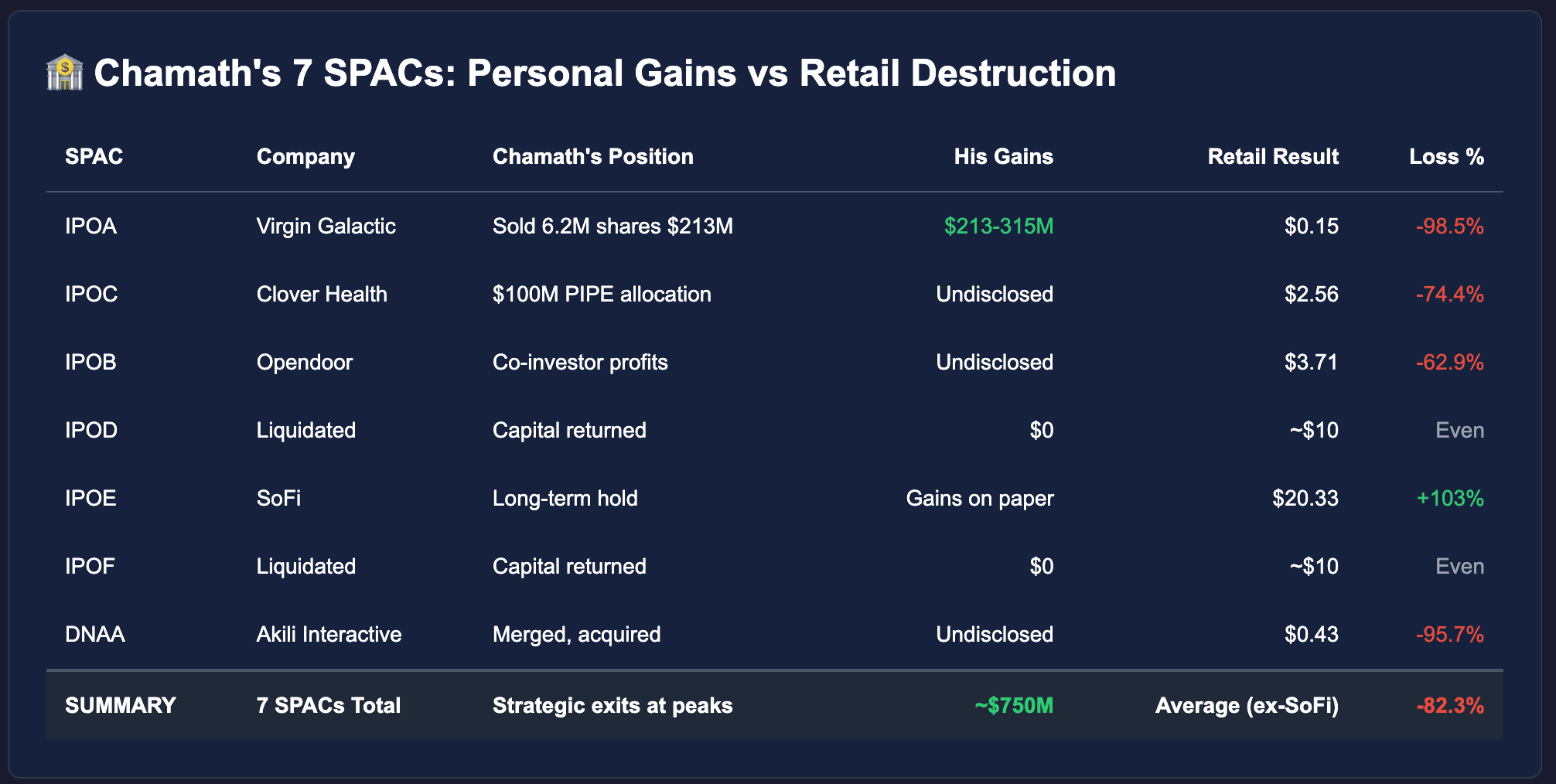
While his Social Capital SPACs ultimately collapsed in value for retail investors, Chamath personally realized an estimated $750 million in gains by trimming positions at peak valuations.
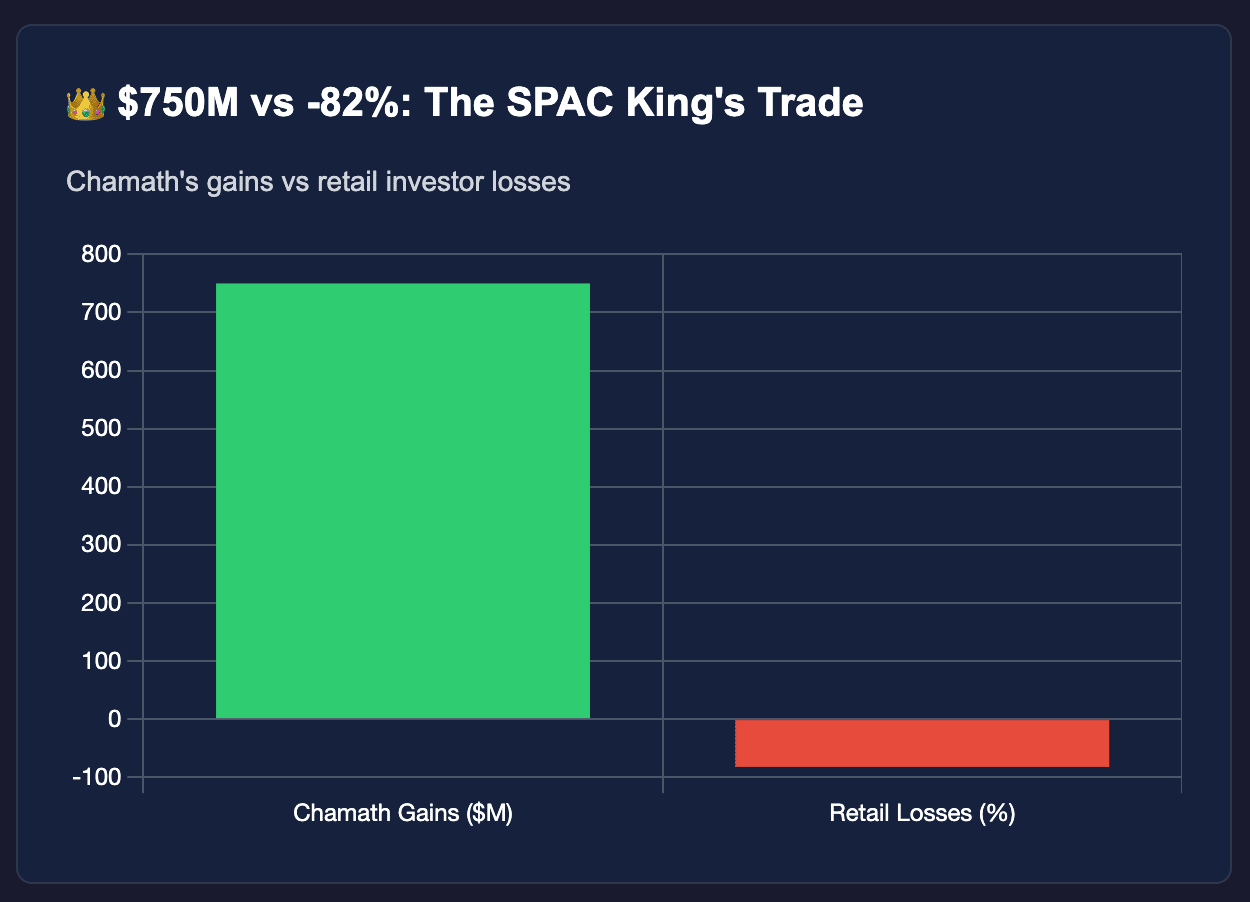
His March 2021 sale of Virgin Galactic shares alone netted $213-315 million. The podcast’s visibility was instrumental in building the “SPAC King” persona that attracted retail capital to these vehicles.
Fundraising and Deal Flow
The podcast functions as a global marketing platform for Craft Ventures (Sacks), LAUNCH (Calacanis), and The Production Board (Friedberg). Enhanced deal flow and easier fundraising from this “influencer effect” is estimated to be worth millions in future carry and management fees. As one attendee noted, the Summit is “a supremely clever piece of brand-building” where the hosts openly admit the pod “lifted their profiles and their businesses.”
Political Capital
The podcast’s visibility directly enabled David Sacks’s December 2024 appointment as the White House “AI & Crypto Czar”—a position that gives him regulatory authority over industries where he holds significant personal investments.
In total, the All-In platform has generated tens of millions in direct revenue and likely $100+ million in indirect value through realized SPAC gains, enhanced fund values, and political influence that allows the hosts to literally write the rules for their own portfolios.
Introducing The Besties Index
Sure they’re grifters. And in my opinion they’re also awful people. But maybe they’re at least helping their following make money.
I mean… That’s their whole thing, right?
They’re the guys who had the foresight to invest in Uber back in the day!
So let’s test whether these guys actually know what they’re doing.
Between 2020 and 2025, the hosts promoted, sponsored, or heavily endorsed 14 specific assets — ranging from Chamath’s SPACs to Sacks’s defense tech darlings to cryptocurrency plays.
I tracked each one, assuming a $1,000 investment at the approximate time of first major promotion through November 11, 2025.
The result is what we’re calling the “Besties Index” — a $14,000 portfolio that tests whether their insider wisdom beats simply buying and holding index funds.
Initial Investment: $14,000
Final Value: $34,251
Cumulative Return: +145% (looks great!)
Money-Weighted IRR: 11.2% annualized
Now let’s compare that 11.2% to what would have happened if you’d simply bought index funds and gone to the beach.
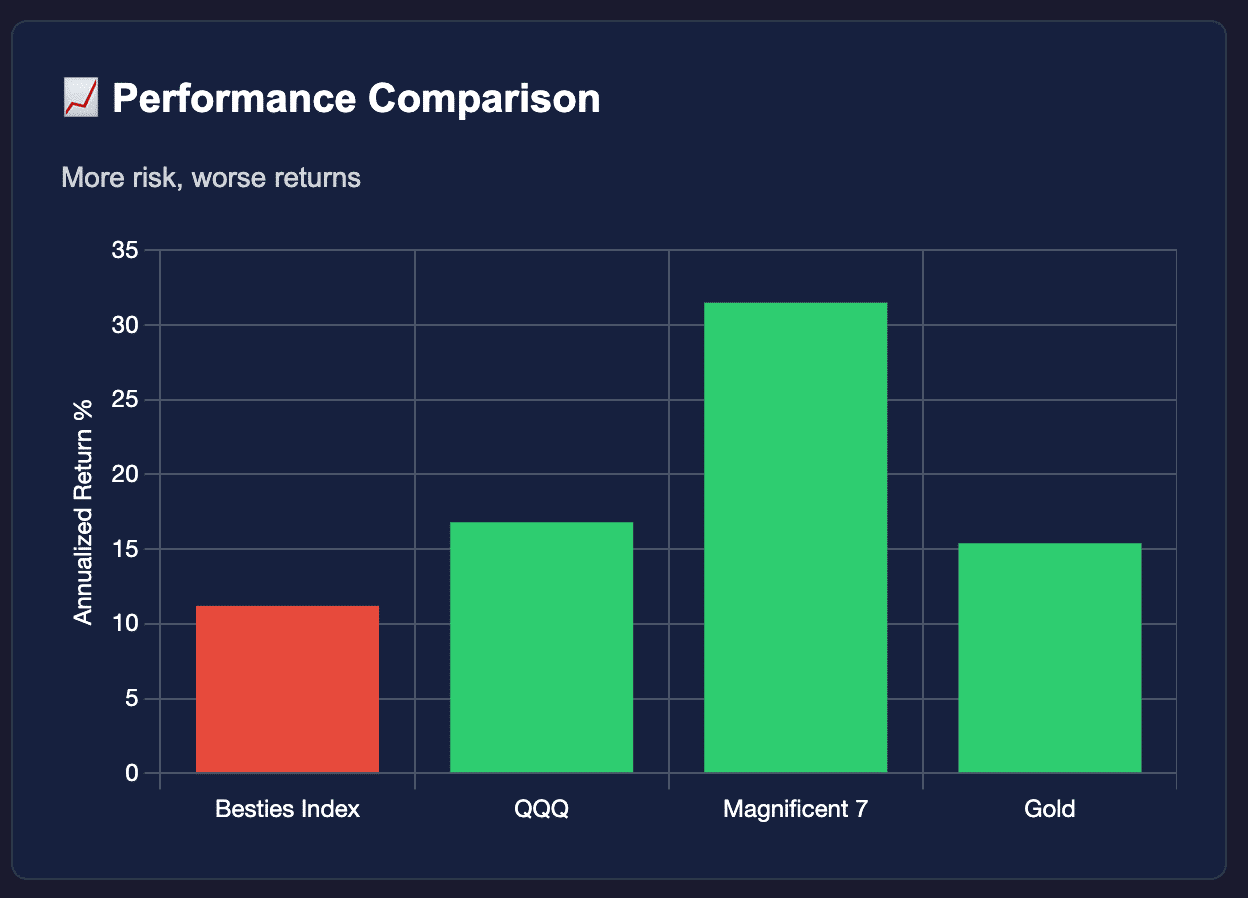
Ok so in absolute return terms, it’s not great, but probably it’s better from a risk-adjusted point of view.
To test that, we’ll derive the sharpe ratio for each investment.
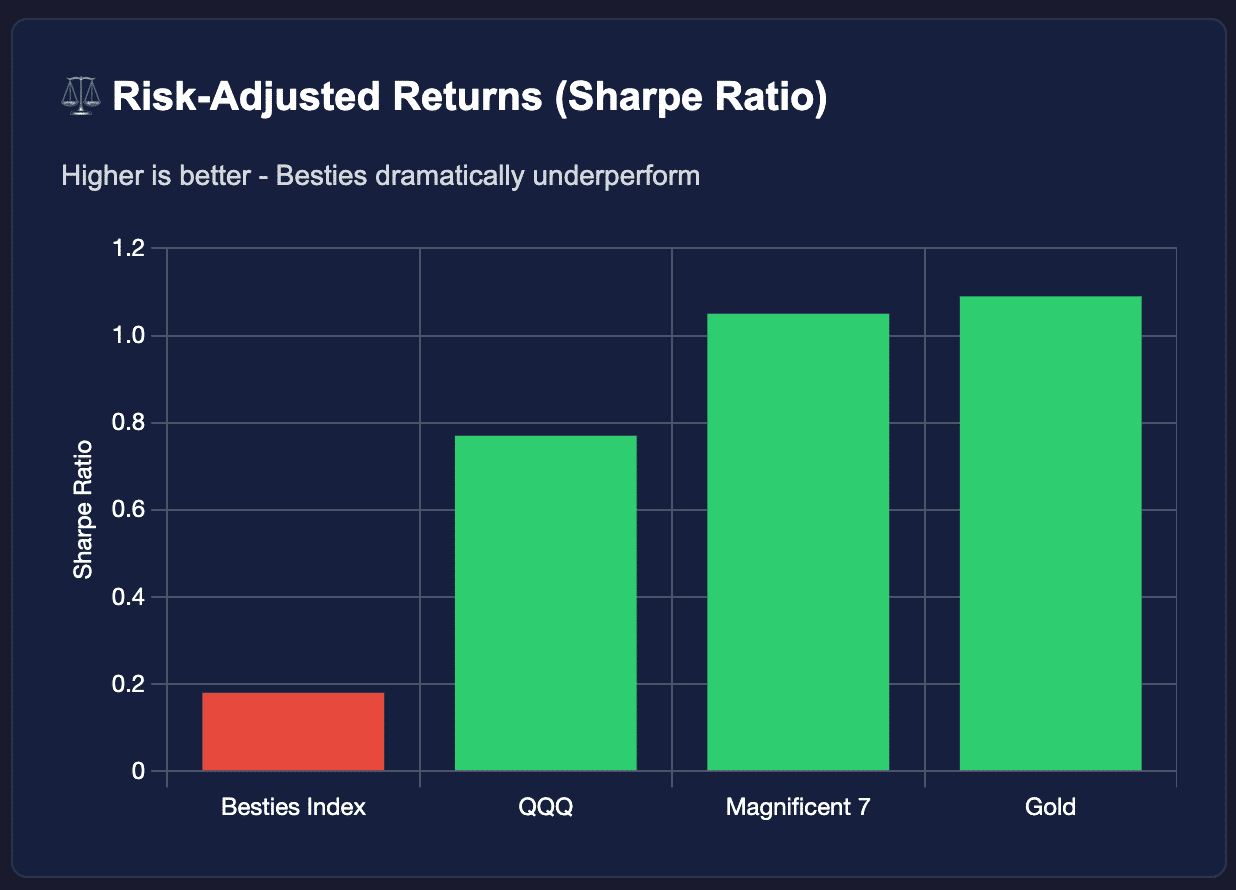
Let me translate this from finance-speak: You took more risk for worse returns.
The Sharpe Ratio measures risk-adjusted performance — how much return you got per unit of volatility. A higher number is better.
The Besties Index’s Sharpe of 0.13-0.22 is dismal. QQQ’s 0.77 means you got roughly 4x better risk-adjusted returns by ignoring the Besties entirely and buying a boring index fund.
Even gold (and I hate gold) beat them on risk-adjusted returns.
Here’s the dirty secret buried in that +145% cumulative return: The entire portfolio’s gains came from three assets:
Bitcoin: +1,212% ($13,125)
Tesla: +394% ($4,944)
Robinhood: +258% ($3,579)
Those three positions represent 84% of the portfolio’s total gains.
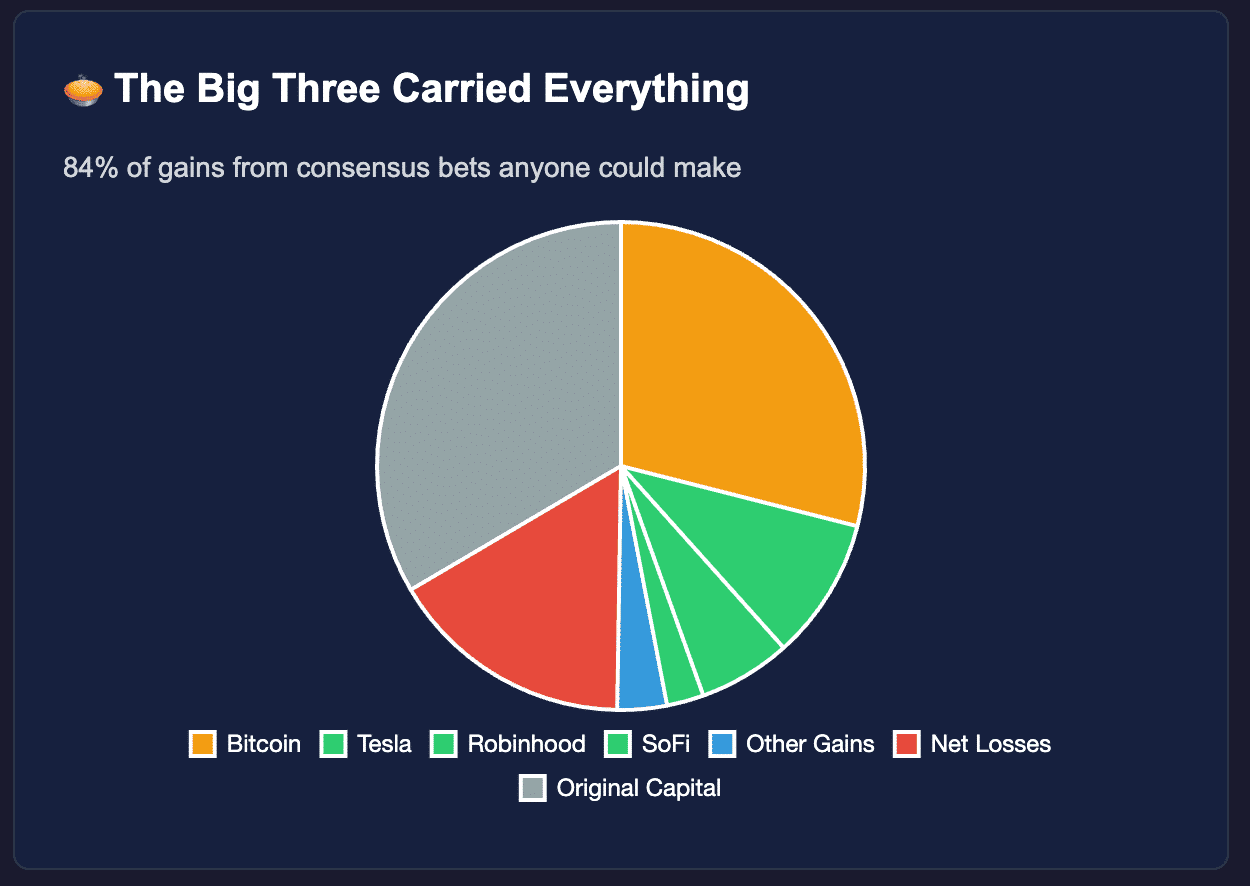
And here’s the thing: these weren’t insider picks. These were consensus tech bets that Cathie Wood, Michael Saylor, and every Redditor on r/wallstreetbets was also making.
Bitcoin? Chamath was late: Michael Saylor had been buying since 2020.
Tesla? Everyone in tech has been long TSLA since 2019.
Robinhood? Jason was an early investor, sure, but the stock’s run-up came from retail trading mania, not genius foresight.
Now look at what happens when you strip out those three.
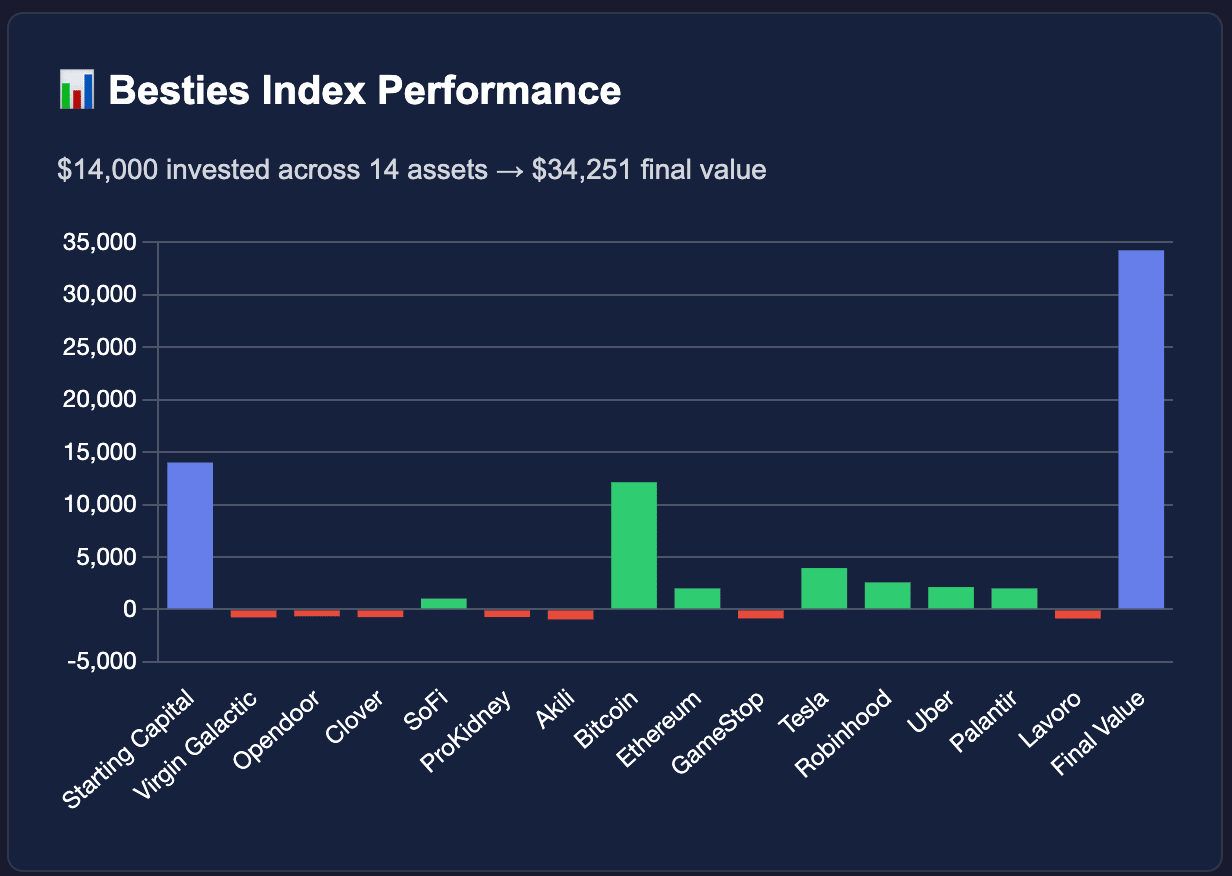
The other 11 assets averaged a -42% loss.
Six of Chamath’s seven SPACs (excluding SoFi) lost an average of -82.3%. Friedberg’s Lavoro SPAC lost 87%. GameStop—which Chamath opportunistically pumped during the meme stock frenzy—lost 86% for anyone who held past his exit.
The Besties Index didn’t beat the market. It was the market (BTC/TSLA/HOOD) plus a graveyard of pumped SPACs that destroyed retail wealth.
$750m vs -82%
Chamath Palihapitiya earned the nickname “SPAC King” during the 2020-2021 boom by taking seven companies public through Special Purpose Acquisition Companies (blank-check vehicles).
He positioned these deals as “democratizing” access to high-growth companies — bringing Virgin Galactic’s space dreams, Clover Health’s Medicare AI, and Opendoor’s real estate platform to Main Street investors.
The pitch was seductive: “The traditional IPO process is broken. We’re leveling the playing field.”
The reality was extracting wealth from retail while insulating himself from losses.
Virgin Galactic
Let’s look at Virgin Galactic to see how this all worked.
Chamath’s IPOA took Virgin Galactic public in October 2019 at an implied $12-15/share valuation. He framed it as a “noble investment” akin to funding the Apollo missions, telling CNBC that Virgin Galactic would “democratize access to space.” The stock opened at $12.34.
Over the next 18 months, Chamath appeared on CNBC, All-In, and Twitter, relentlessly promoting the company. By February 2021, the stock hit $63—a 5x return. Retail piled in, convinced they were early to the next SpaceX.
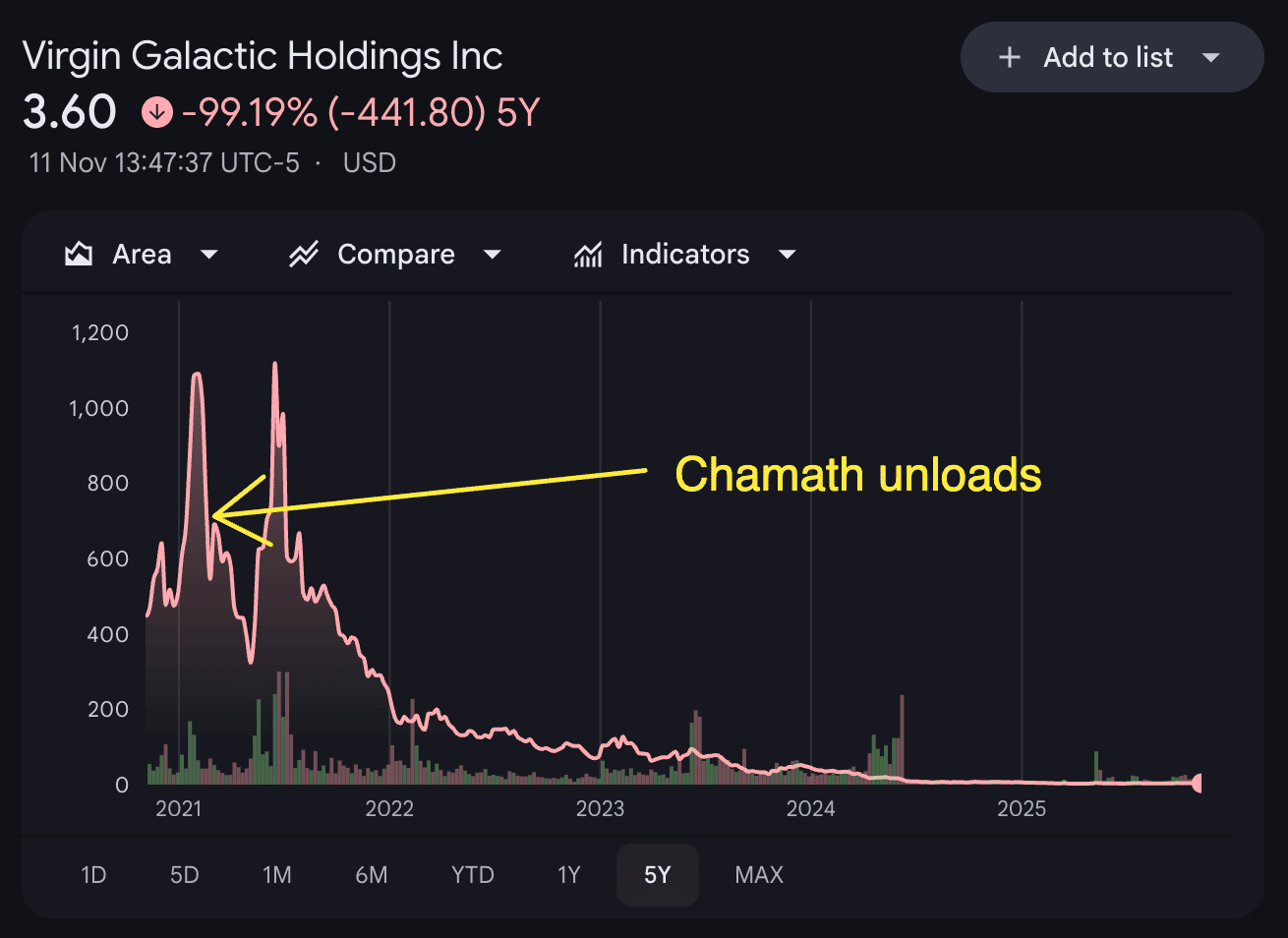
On March 2, 2021, Chamath—who was still serving as the company’s Chairman—sold his entire personal stake. SEC filings show he offloaded 6.2 million shares for approximately $213 million (some reports cite $315M for a 10M share sale).
Within months, Virgin Galactic’s spacecraft encountered repeated technical failures. A 2022 investor lawsuit alleged that Chamath and Richard Branson had dumped their shares while “aware of and concealing defects” in the spacecraft, which were “severely flawed and nowhere near flightworthy.”
The stock cratered. After a 1-for-20 reverse split in 2023, Virgin Galactic trades at ~$3.60 as of November 2025—equivalent to $0.18 pre-split. Retail investors who bought at $15 and held have lost 98.5%.
Chamath resigned from the board in February 2022, one month after his “nobody cares about the Uyghurs” comments forced the Warriors to distance themselves from him.
Clover Health
If Virgin Galactic was negligence, Clover Health was closer to fraud — or at least, that’s what the lawsuits allege.
In January 2021, Chamath’s IPOC took Clover Health public, touting its “best-in-class technology” for Medicare Advantage plans. Chamath committed $100m to the PIPE, locking in his position.
Two weeks later, short-seller Hindenburg Research dropped a bombshell: Clover Health was under active, undisclosed investigation by the Department of Justice for at least 12 issues, including kickbacks, misleading marketing, and undisclosed third-party deals. The investigation was a “potential existential risk” that Chamath had failed to disclose to investors.
The stock collapsed. Multiple securities class-action lawsuits followed, alleging Chamath “misled investors.” The company eventually settled the civil litigation in 2023.
As of November 2025, Clover Health trades at ~$2.60—down 74.4% from its $10 SPAC listing.
American Exceptionalism Acquisition Corp
In August 2025, after the SPAC graveyard was fully excavated, Chamath filed for a new blank-check company: American Exceptionalism Acquisition Corp. ($AEXA).
The S-1 filing contained an extraordinary disclosure—equal parts liability waiver and confession:
“We believe that this investment is most suitable for institutional investors, and retail investors should approach with caution, if at all. We believe that retail investors should only participate if… (b) this investment is a quantum of capital they can afford to completely lose and (c) if they do lose their entire capital, they will embody the adage from President Trump that there can be ‘no crying in the casino.’”
After retail investors lost an average of 82% on his prior SPACs while he personally cleared $750 million, Chamath is now warning future victims: “I’m about to do it again, and you have no right to complain.”
The Trump quote is the chef’s kiss — a liability shield disguised as blue-collar populism. It’s the same Trump who appointed Chamath’s co-host David Sacks to regulate the crypto and AI industries where they’re both heavily invested.
Regulatory capture in real-time
If Chamath’s SPAC empire was about extracting retail wealth, David Sacks’s trajectory is about converting media influence into state power — and then using that power to benefit his portfolio.
David Sacks’s venture firm, Craft Ventures, has been a prolific investor in crypto and AI startups. Among its portfolio companies:
Bitwise Asset Management (invested 2017): A leading cryptocurrency index fund provider
Palantir Technologies (angel investment): Defense/AI company
SpaceX (angel investment): Elon Musk’s aerospace company
20+ other “unicorns” across crypto, AI, and defense tech
Craft Ventures also co-invested in Chamath’s Opendoor SPAC via the PIPE round—an example of how the Besties’ financial interests are deeply intertwined.
On the All-In Podcast, Sacks has been a vocal advocate for crypto deregulation, opposition to AI safety regulations, increased defense spending on tech, and free-market policies that benefit his portfolio.
This was sort of fine when he was just a podcaster. But in December 2024, everything changed.
On December 12, 2024, President-elect Donald Trump announced that David Sacks would serve as White House AI & Crypto Czar—a newly created role to “provide regulatory clarity” and “safeguard free speech online.”
Bloomberg News confirmed the appointment, noting Sacks’s long-standing opposition to tech regulation. The position is structured as a “Special Government Employee” (SGE), limiting him to 130 days of service per year—a deliberate loophole that explicitly allows him to remain a general partner at Craft Ventures while simultaneously regulating the industries in which his fund is invested.
On March 5, 2025, the Trump White House issued Sacks a “blanket ethics waiver” explicitly clearing him to “work on regulatory issues directly related to his financial holdings,” concluding his interests are “not so substantial as to be deemed likely to affect the integrity of your services.”
“We know you’re conflicted. We don’t care.”
The smoking gun came in early 2025 with the announcement of President Trump’s “Crypto Strategic Reserve.”
Here’s the problem: Those five assets are the exact top five holdings of Bitwise’s main index fund.
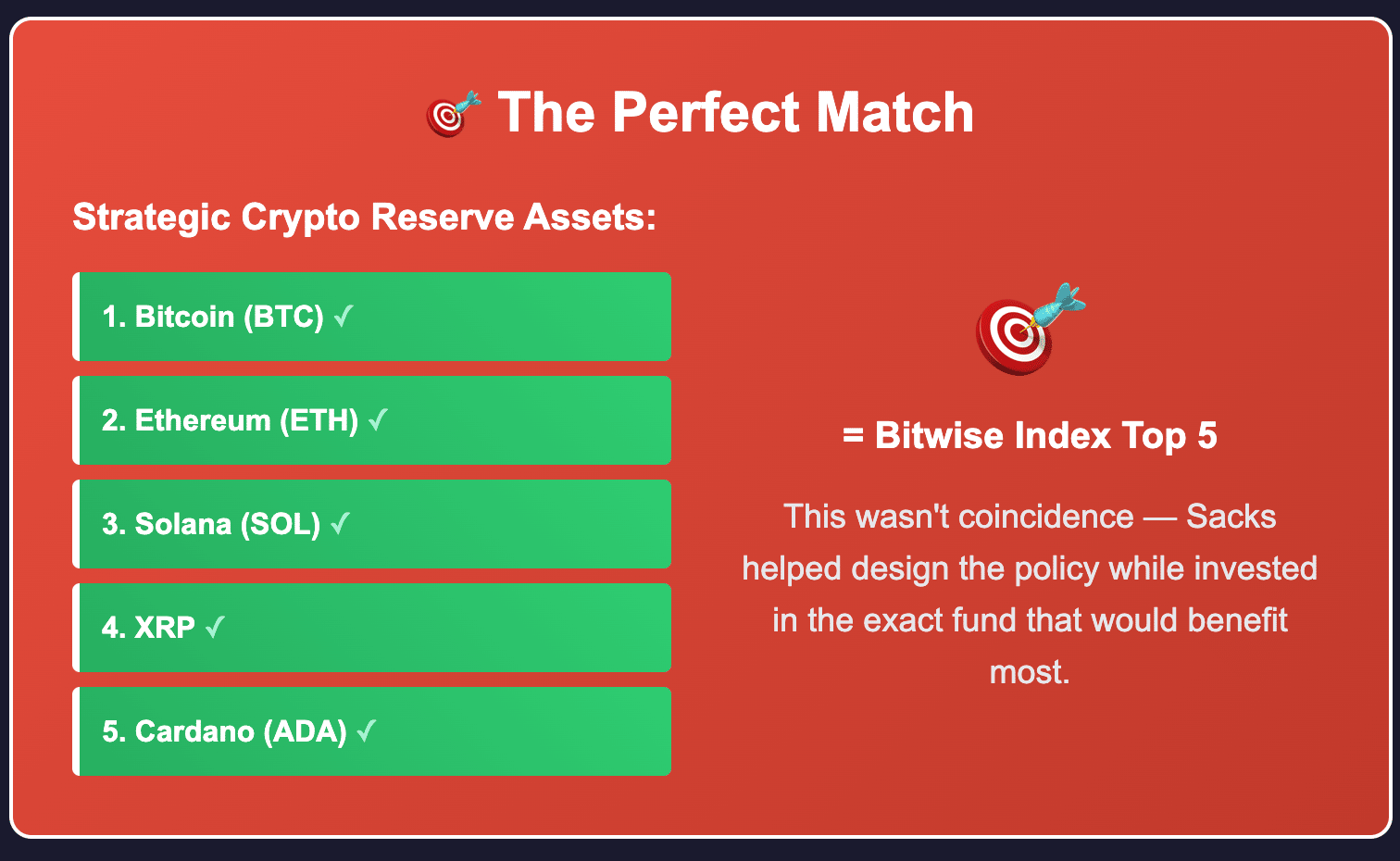
The President’s announcement—a state endorsement of those assets—sent prices surging, directly enriching Bitwise Asset Management, Sacks’s own portfolio company.
Senator Elizabeth Warren’s Banking Committee demanded answers on whether Sacks or his associates sold into the rally. His defense? He’d divested his Bitwise stake in January 2025—after helping craft the policy but before it was announced.
That timing, combined with the White House’s earlier blanket ethics waiver allowing him to regulate industries in which he held financial interests, made the conflict unmistakable.
This is a confession, not a defense. It proves he was fully invested in the asset that would benefit most from the policy he was designing, and that he conveniently divested right before the announcement that he knew was coming.
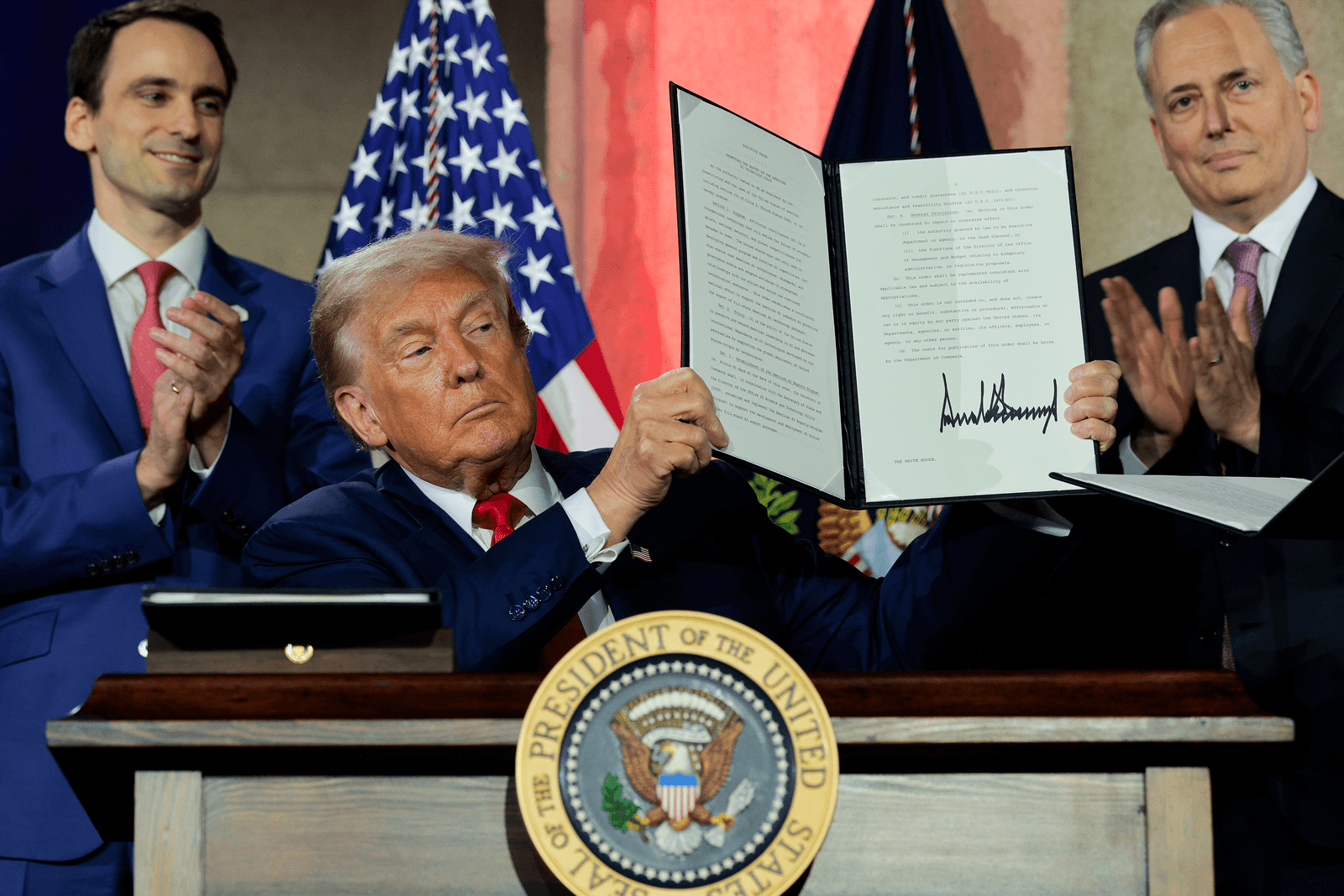
Whether he personally profited or simply tipped off his LPs and partners, the sequence of events is insider trading—except it’s legal because he’s regulating policy, not securities.
The Bitwise scandal is just one example. Sacks’s entire role is a structural conflict:
As AI Czar, he advocates a “pro-industry, deregulatory approach” that opposes “social agendas” in AI models—conveniently removing regulatory burdens from his AI portfolio companies
He advocates “harnessing AI technologies for defense purposes”—driving government contracts to Palantir, where he’s an angel investor
He chairs the President’s Working Group on Digital Asset Markets to “provide regulatory clarity”—allowing him to write the exact rules his crypto investments need to thrive
His close alliance with Elon Musk (who headed the Dept. of Government Efficiency) allows him to advocate for policies and contracts that benefit SpaceX, where he’s also an investor
The podcast manufactured the fame, the fame bought political access, and the access is now being monetized to reshape entire industries in favor of the Besties’ portfolios.
If you’re not paying, you’re the product
The entire All-In financial empire, from the Summit to the SPACs to the political appointments, rests on one foundation: a devoted audience willing to buy anything the Besties sell.
In September 2025, Vanity Fair sent a reporter to the All-In Summit. What they found was described as a “fever-dream capitalist bacchanal” and a “chest-thumping celebration of capitalism” where attendees openly admitted the podcast had changed their political affiliation.
One self-proclaimed “All-In superfan” summarized: “They’ve built a cult following that very much inspires people to go out and start their own thing.”
The Summit isn’t a conference—it’s a multi-day immersion in the Besties’ worldview. North Ridge Partners’ account noted it was equal parts “tech conference” and “political rally,” with “nonstop fundraising pitches” and an atmosphere where attendees were “the product” being sold to each other.
It’s is a weird cult meeting for rich guys who idolize the Besties and that reinforces their guru status.
But what’s the playbook that translates that into easy money?
Here’s how the economics work:
The hosts use the podcast to build trust and authority
They promote an asset or idea (SPAC, crypto, political candidate)
Their audience, trusting them as “insiders,” invests capital or attention
The hosts exit or pivot while the audience holds the bag
An easy and oft-cited example:
In January 2021, during the WallStreetBets frenzy, Chamath opportunistically jumped on the GameStop bandwagon. He tweeted that he’d bought call options, went on CNBC to argue “the little guys had a point,” and positioned himself as a retail champion.
He cashed out his position within days and donated the profits to charity (a PR move).
Listeners who treated his enthusiasm as a long-term endorsement and held GME have lost 86%. The stock, which traded at $150 during the peak, now sits at $21.
Chamath’s defense: “It was always a trade, not an investment.”
The reality: He never clarified that on air. He let the audience think he was “HODL-ing” while he dumped.
Listen to the interview, decide for yourself
When hosts promote an asset, the audience becomes the buyer at precisely the moment insiders want to sell.
David Friedberg brands himself as the “objective scientist,” delivering academic-sounding monologues on climate, soil, and food tech. But as CEO of The Production Board — which builds startups in those same sectors — his supposed lessons are really undisclosed ads for his own portfolio.
Examples:
When he discusses quinoa’s “energy efficiency” as a protein source, he’s pumping NorQuin — TPB’s first investment
When he discusses soil biology and predictive agronomy, he’s pumping Pattern Ag — where he’s a director
When he discusses Latin American ag-retail, he’s pumping Lavoro— his SPAC (which lost 87%)
An interview with AgFunderNews made the conflict explicit. When asked about TPB’s investment thesis, Friedberg’s explanation was identical to his podcast monologues: “If you look at the energy efficiency of quinoa as a protein source, it rises to the top…”
He’s not educating; he’s marketing. But because he delivers it in the tone of a university lecturer, listeners don’t recognize they’re hearing an infomercial.
So what now?
The casino always wins because the casino makes the rules. And when the casino’s co-host gets appointed to literally write the regulations for his own industry, the house edge becomes infinite.
Chamath’s “no crying in the casino” line isn’t a warning—it’s a taunt. He’s telling you exactly what he’s doing, daring you to stop him, knowing you won’t because you’re too busy trying to get rich like him.
The All-In Podcast isn’t a media company. It’s a financial empire that discovered the most profitable asset class isn’t SPACs or crypto — it’s you.
That’s all for this week; I hope you enjoyed it.
Cheers,
Wyatt

Disclosures & Disclaimers The information contained in this newsletter is provided for general informational purposes only and does not constitute investment, legal, tax, or other professional advice. Altea does not offer or sell securities through this newsletter. Any references to investment opportunities are not offers to buy or sell any security. You should not construe any such references as a recommendation to invest.
All investments carry risk and may result in loss. You are solely responsible for conducting your own due diligence and consulting with your own legal, tax, and investment advisors before making any investment decisions.
Altea does not guarantee the accuracy or completeness of information provided by third parties. Past performance is not indicative of future results.
Only accredited investors, as defined by applicable laws, may participate in Altea investment opportunities.
NYT comes out swinging against Sacks.
You love to see it: https://www.nytimes.com/2025/11/30/technology/david-sacks-white-house-profits.html