

Let's get landlocked

Welcome to the WC.
Fresh off our deep dive into the island territory of Puerto Rico, this week’s WC focuses on six countries that don’t have any water at all.
They’re...landlocked but still beautiful.
There are a total of 44 countries with no access to the sea, and two of them are doubly landlocked, which means none of the countries they touch have access either.
Most of them are super poor and never really got started. But the six we talk about today have made a real go of it, and they’ve each done it in their own way.
Nothing here is investment advice. Do your own research. Please.
Let’s go
Geography is destiny.
No port means no easy trade, which means no easy money. Look at a map of GDP per capita, and it basically tracks a map of the coastline.
The richest clusters sit on water. The poorest are stuck a thousand miles from the nearest dock, paying someone else’s toll to get a container out.
There are 44 landlocked countries. Two of them are so landlocked that every neighbour they touch is also landlocked – Liechtenstein and Uzbekistan, doubly cursed.
Most of the 44 sit exactly where you’d expect on the income table. Chad. Niger. The Central African Republic. No coast, no cash, story checks out.
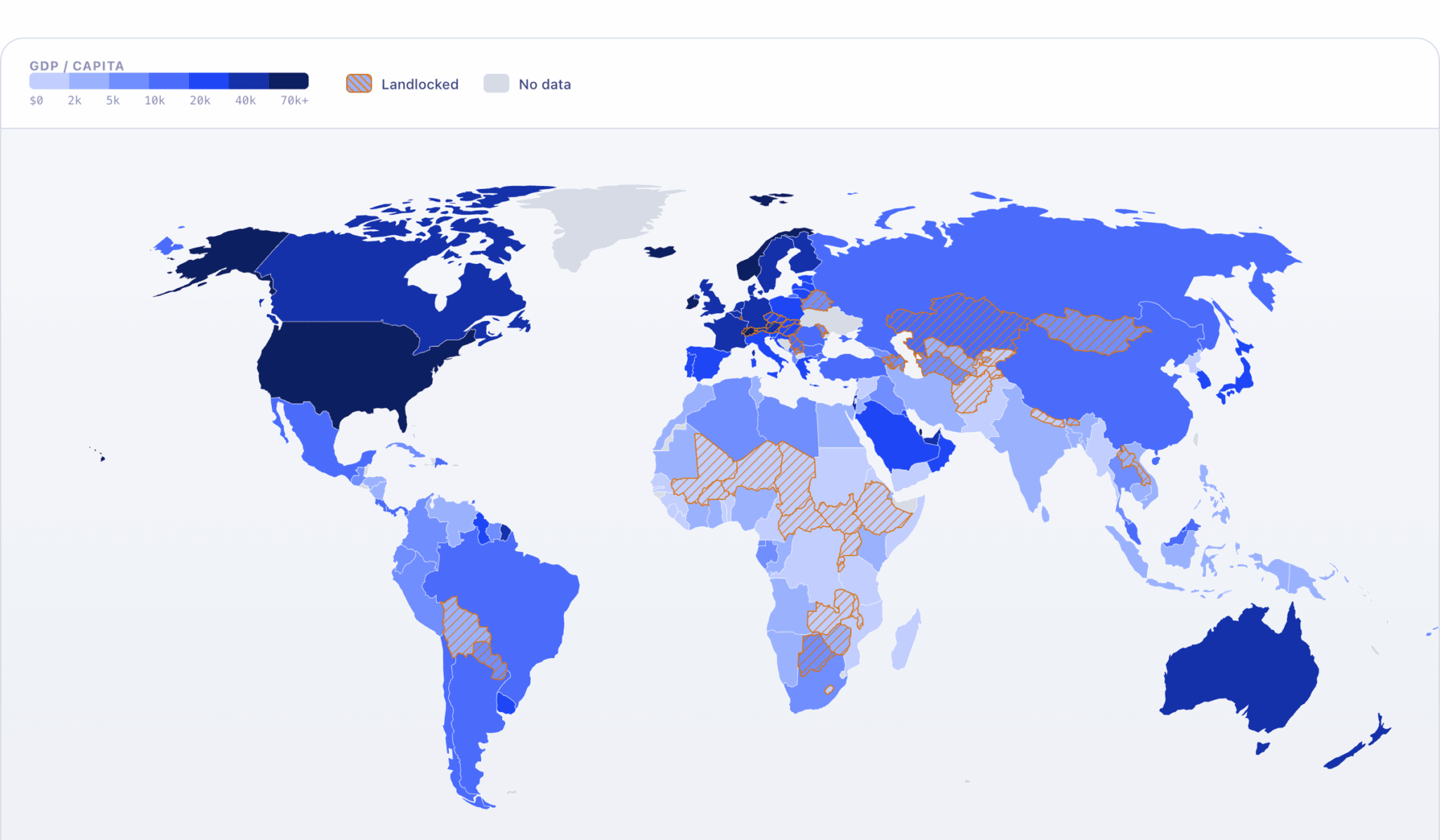
Then there’s a handful that read the map and got creative.
In today’s WC, we’ll dig into six, including Paraguay -- because we’re running a Paraguay investment opportunity this week.
In every case, the government overcame immense challenges to find a creative way out of its landlocked hole. It’s always a law, a treaty, or a niche industry that no one else thought to create, because they didn’t have to.
Paraguay
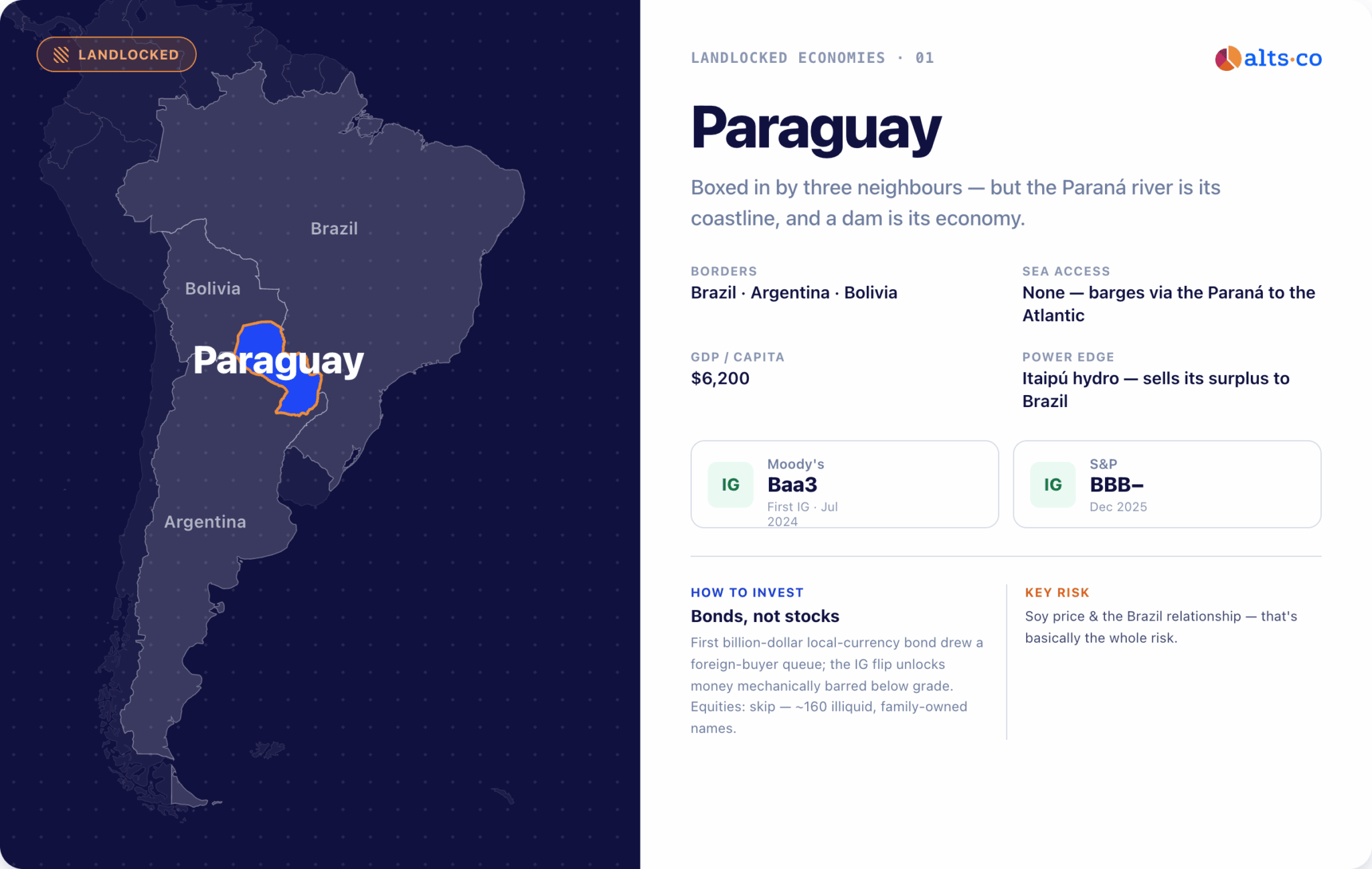
Boxed in by Brazil, Argentina and Bolivia. Not fully cut off though – the Paraná river does the job a coastline would, floating soy and beef barges out to the Atlantic.
The country lost more than half its population in a 19th-century war against its neighbours, which is about as close to a national death sentence as a country gets. A dam saved the tiny country.
Itaipú, shared with Brazil, is one of the largest hydro plants on the planet, and Paraguay only uses a sliver of its half.
The economic engine:
Sells the rest to Brazil,
Tax everyone at a flat 10%
And you’ve built a magnet for aluminium smelters and, more recently, bitcoin miners chasing cheap power.
Moody’s gave Paraguay its first investment-grade rating in July 2024. S&P followed with a BBB- in December 2025. These upticks mean institutions can now buy the country’s debt.
Want in as an individual? Bonds, not stocks.
Paraguay just placed its first billion-dollar local-currency bond and foreign buyers queued up for it.
The stock exchange?
Skip it – 160 names, mostly family-owned, and nobody wants to list. Watch the soy price and the Brazil relationship. That’s basically the whole risk.
Botswana
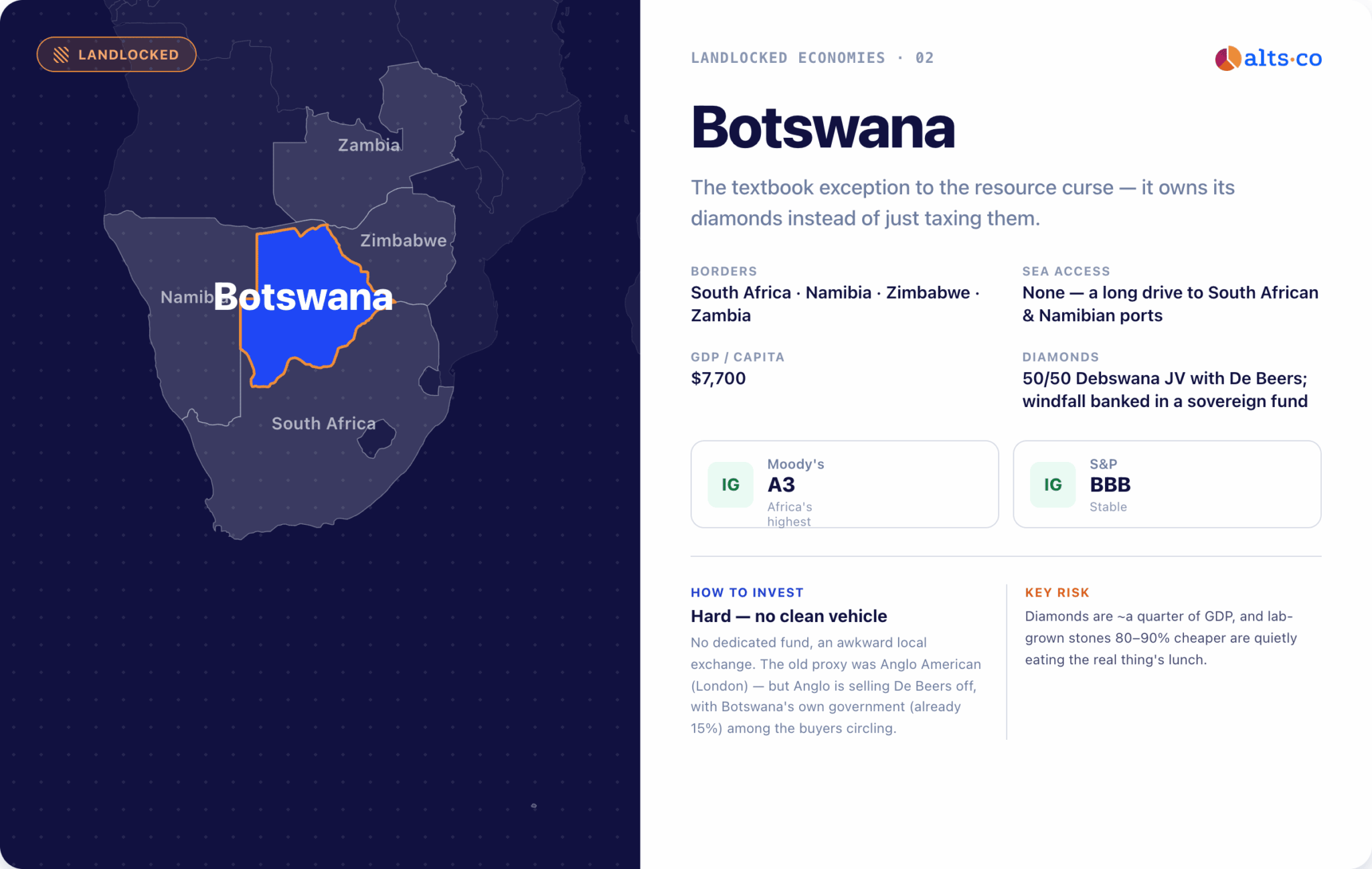
Kalahari, landlocked, exports leave through South African and Namibian ports a very long drive away.
The country’s one weird trick to wealth: Botswana owns its diamonds instead of just taxing them.
Debswana, the mine, is a genuine 50/50 joint venture with De Beers rather than the more standard royalty agreement. The government banked the windfall in a sovereign fund instead of doing what basically every other resource-rich country in history has done, which is steal it.
Botswana was one of the poorest countries on earth at independence in 1966. Today, it’s solidly middle-income. The textbook exception to the resource curse, and there’s a reason people write textbooks about it – almost nobody else pulls this off.
Getting exposure is a genuine headache.
No fund, awkward local exchange. The old workaround was owning Anglo American in London, but Anglo is actively selling De Beers off completely, and one of the parties circling the deal is Botswana’s own government, which already holds 15% and might go bigger.
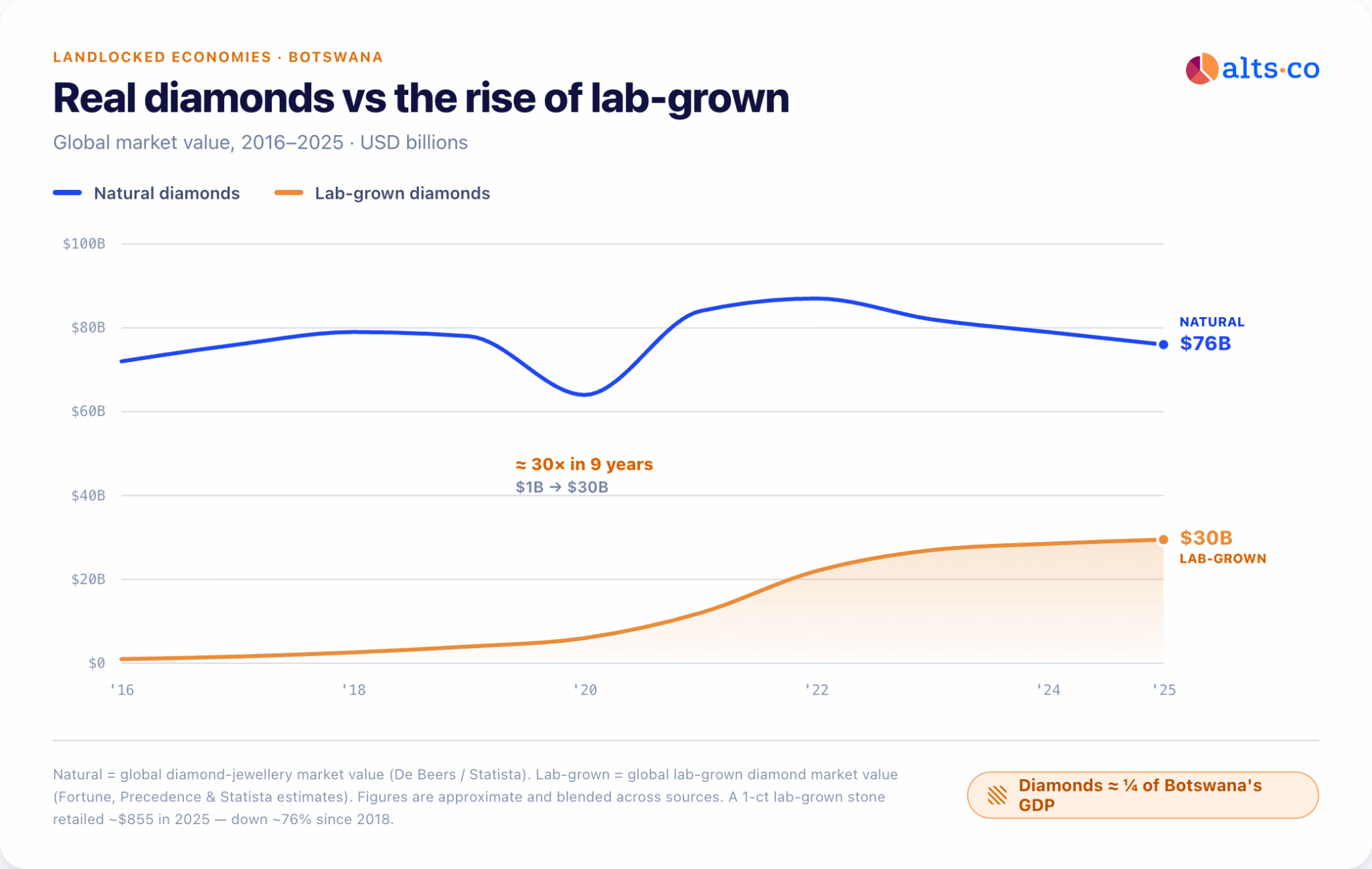
If a country ends up owning the whole diamond monopoly it helped build, that’s worth watching closely. The risk is bigger, and it’s out of Gaborone’s hands: diamonds are a quarter of GDP, and lab-grown stones running 80 to 90% cheaper are quietly eating the real thing’s lunch.
Luxembourg
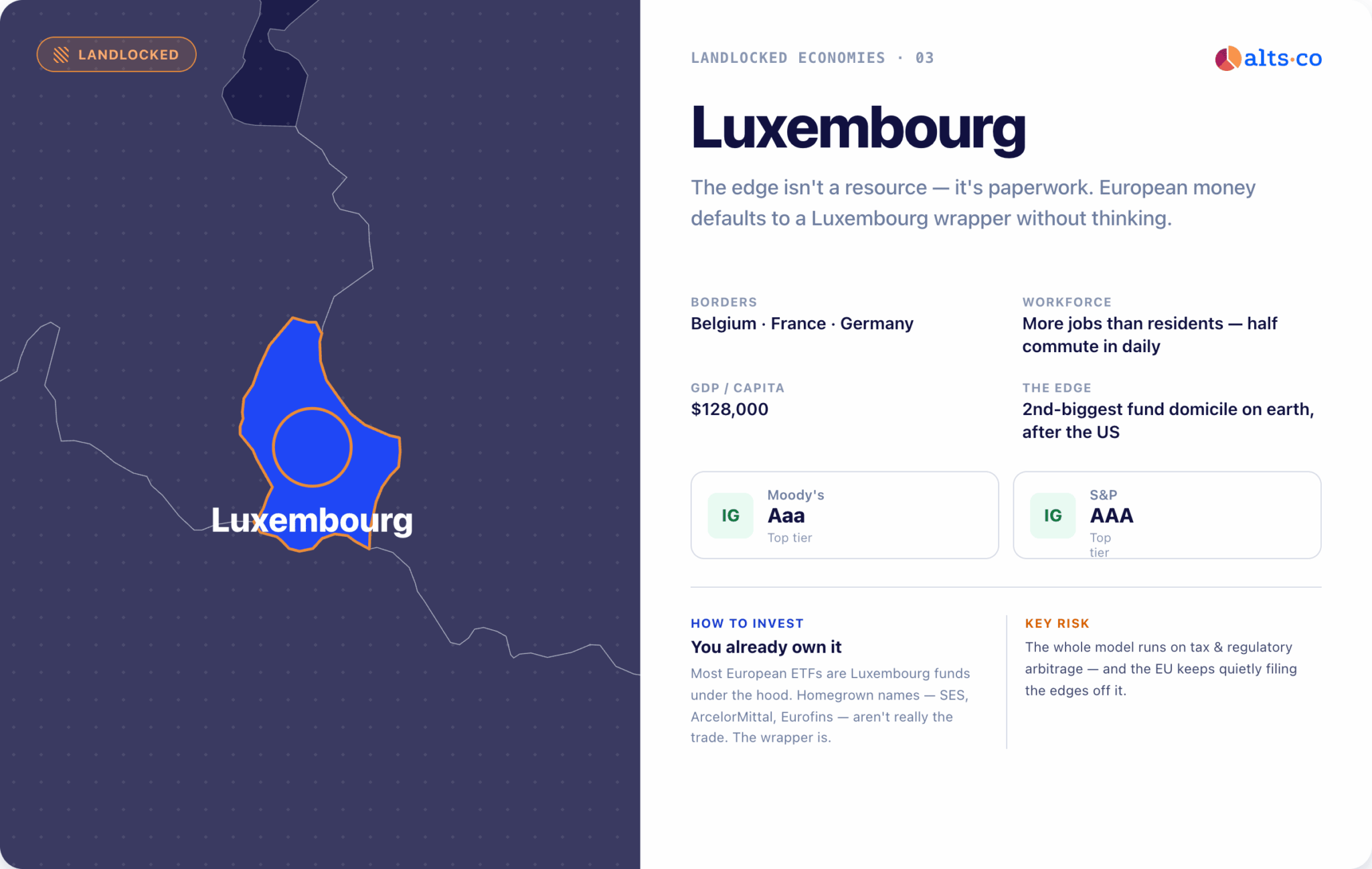
Tiny. Landlocked. Squeezed between Belgium, France, and Germany and little more than a speed bump as the Imperial German Army beat a path to France.
More jobs than residents, so half the workforce commutes from another country every morning.
The edge here isn’t a resource. It’s paperwork. Luxembourg wrote the fund rulebook before anyone else got around to it, so when European money needs somewhere to live, it defaults to a Luxembourg wrapper without really thinking about it. It’s not exciting, but it’s extremely profitable.
Luxembourg was originally a steel town that reinvented itself as the back-office plumbing of the entire European fund industry. It’s the second-biggest fund domicile on earth now, after the US.
Most European ETFs are Luxembourg funds under the hood, and nobody ever mentions it. For actual homegrown companies, there’s SES, ArcelorMittal, Eurofins – but that’s not really the trade, and the model might be in trouble.
The whole thing runs on tax and regulatory arbitrage, and the EU keeps quietly filing the edges off it.
Bhutan
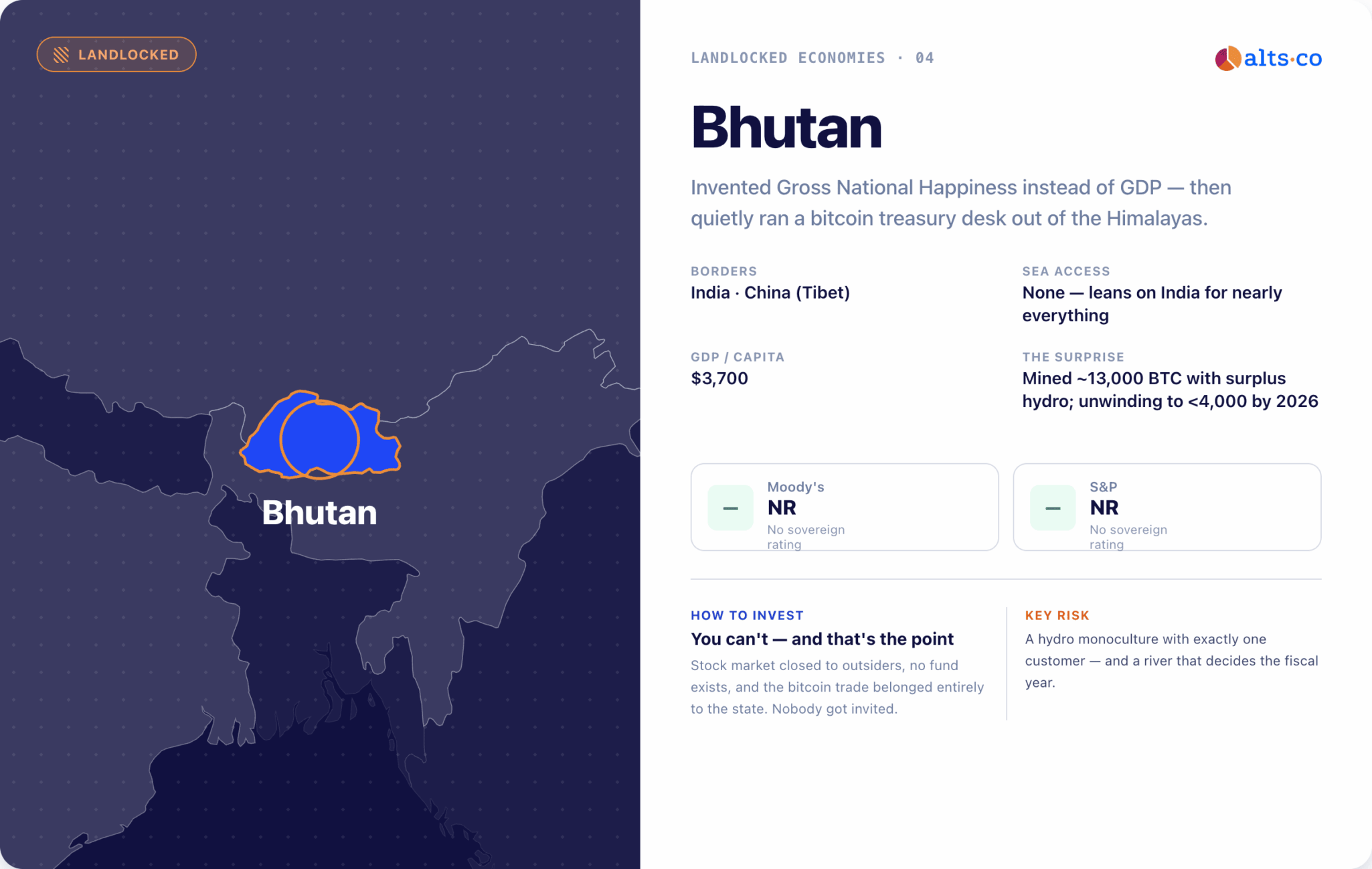
Himalayan. Landlocked. Leans on India for pretty much everything that isn’t grown locally.
Sealed off from the outside world until the 1960s. Famous for inventing Gross National Happiness instead of tracking GDP like everyone else. Sells scarce, expensive tourism – you pay a daily fee just to be allowed in.
Starting quietly in 2019, Bhutan started mining bitcoin with its surplus hydropower – electricity that would’ve been wasted anyway, so the coins cost basically nothing to produce. By late 2024, the kingdom was sitting on roughly 13,000 bitcoin. It’s an absurd number for a country under a million people.
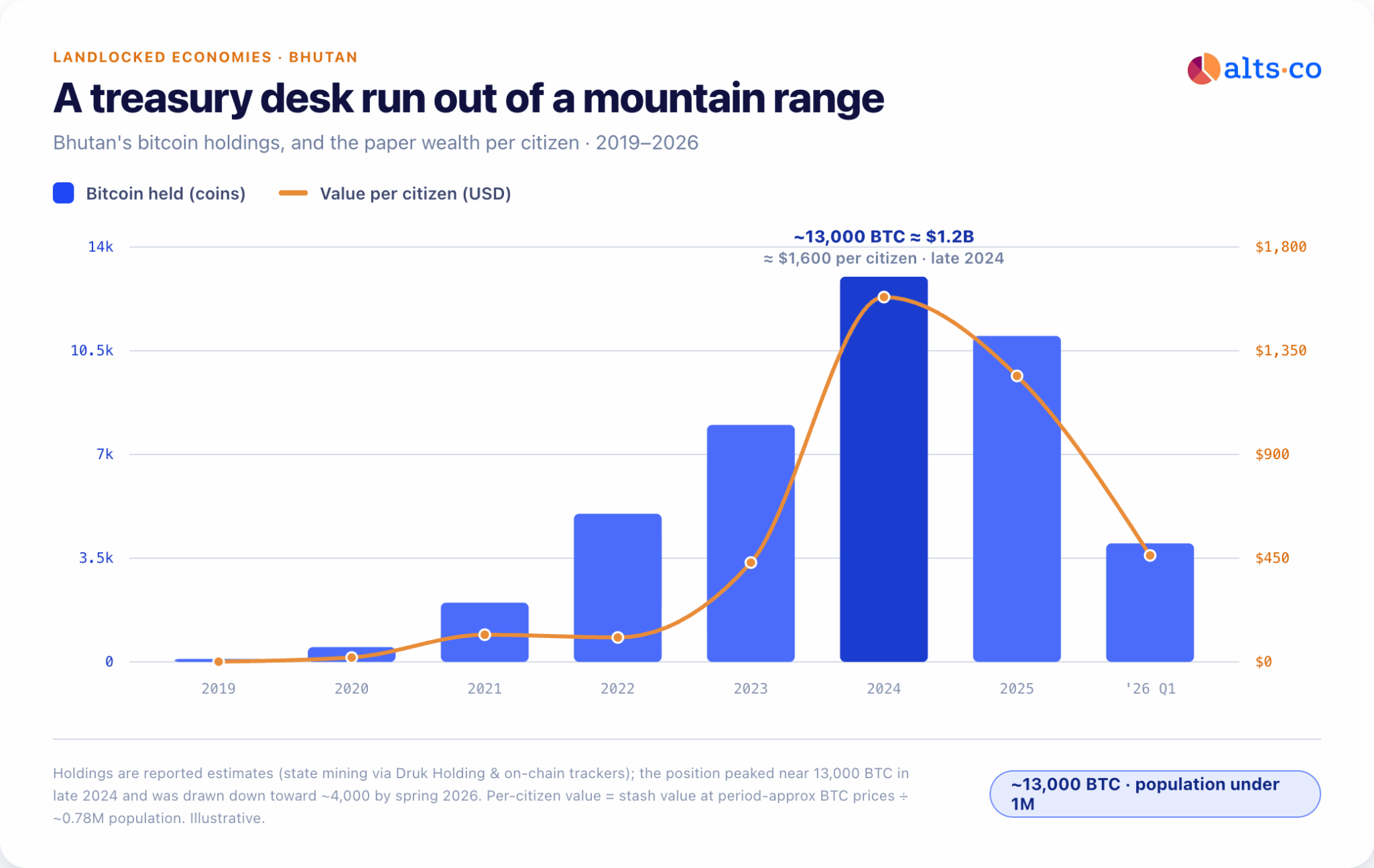
Through 2026 it’s been unwinding the position, small sale after small sale so it doesn’t spook the market, down to under 4,000 coins by spring. It’s a country running a treasury desk out of a mountain range. I bet even junior associates have great views.
You can’t invest in it, and that’s the whole point. The stock market’s closed to outsiders, no fund exists, and the bitcoin trade belonged entirely to the state. Nobody got invited. If you could get in, the risk is a hydro monoculture with exactly one customer, and a river that decides the fiscal year.
Liechtenstein
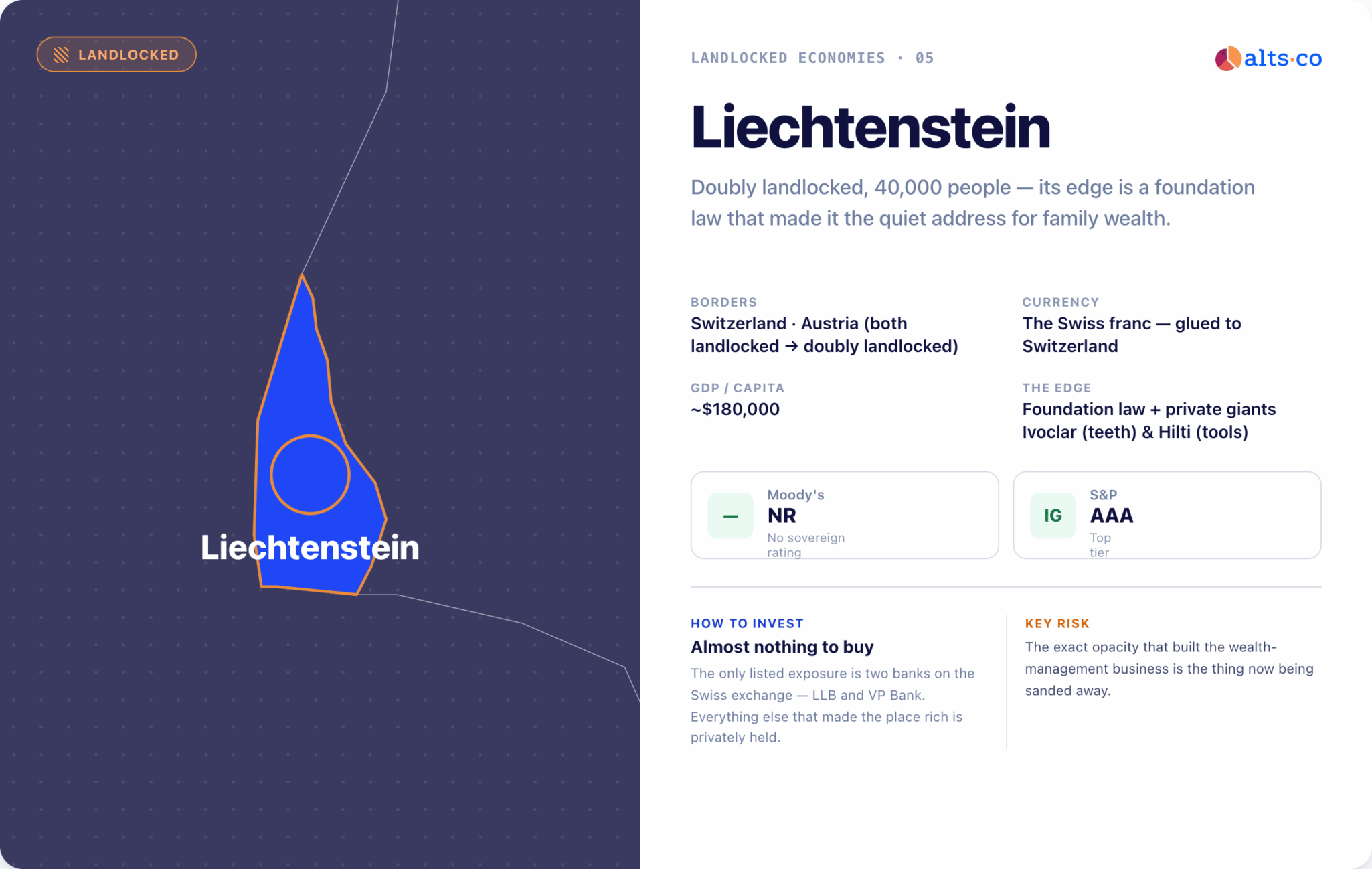
Doubly landlocked. Glued to Switzerland, uses the franc, and imports most of its own workforce daily.
Forty thousand people. More jobs than residents. The edge is a piece of legislation – Liechtenstein wrote the foundation law that made it the address of choice for family wealth wanting to pass quietly between generations. Stack a couple of oddly dominant private companies on top and you’ve got the whole economy.
Ivoclar makes a huge share of the world’s false teeth. Hilti makes the power tools on every construction site in Europe. Neither one is public, so you can’t touch them directly, which tells you something about how this country actually works.
The 2008 stolen-data scandal forced a slow, painful retreat from secrecy toward something closer to transparency. That retreat is still going.
The only listed exposure is two banks on the Swiss exchange, LLB and VP Bank. Everything else that made the place rich is privately held. The risk is that the exact opacity that built the wealth-management business is the thing being sanded away.
Switzerland
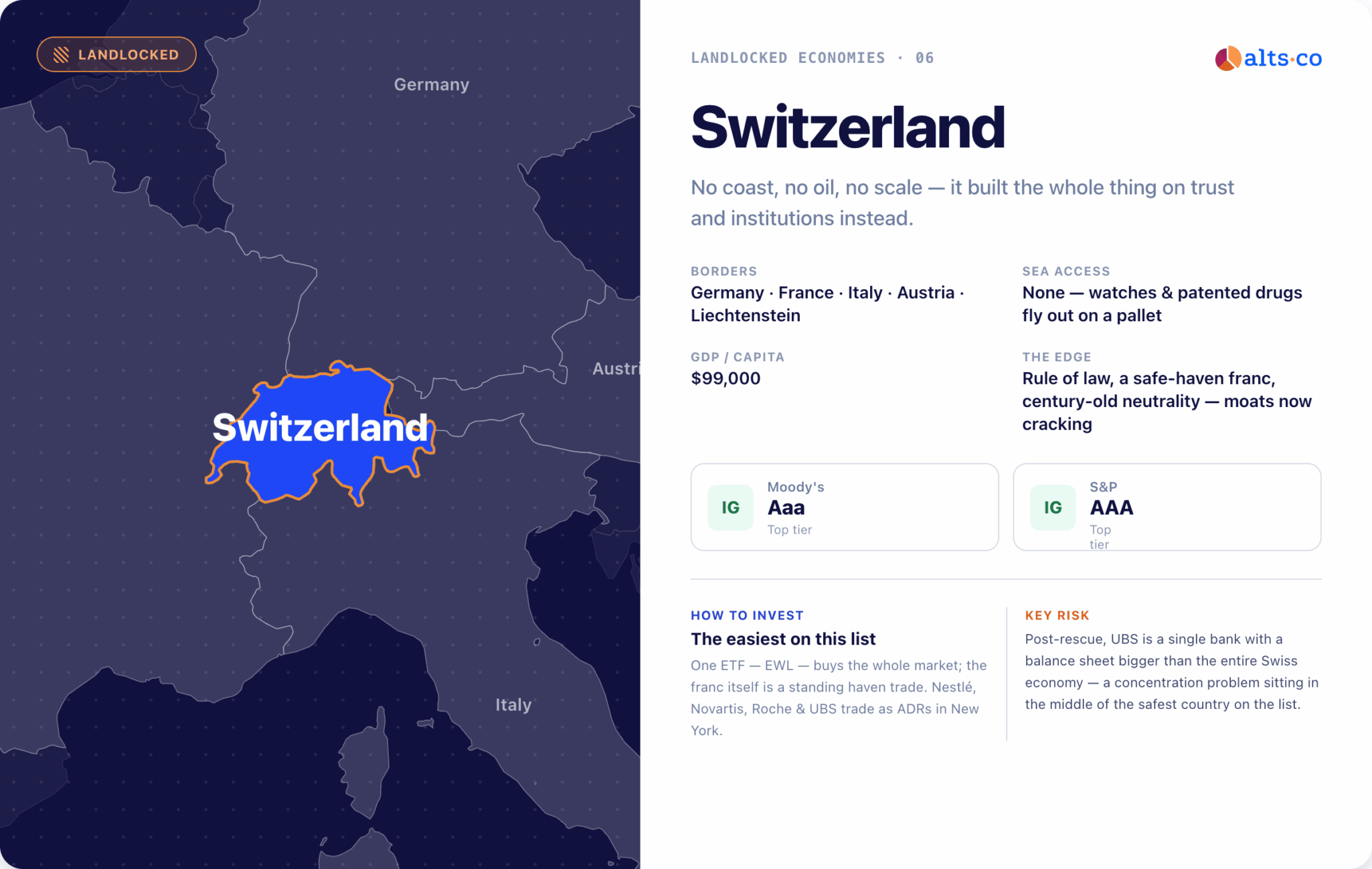
Switzerland is one of the most mountainous countries in the world, and it’s hundreds of miles from the nearest port, so big, bulky items don’t work for export.
You know what’s small and valuable? Watches and patented drugs.
Switzerland’s edge is trust. Rule of law nobody questions, a currency people run toward during a crisis, neutrality sold as an actual product for over a century. No coast, no oil, no scale; they built the whole thing on institutions instead. And Nazi loot.
The country may be in trouble, though. Banking secrecy is mostly gone, forced out by FATCA and automatic information sharing. Neutrality took a real hit when Switzerland signed on to the Russia sanctions. And in 2023, Credit Suisse – 167 years old – collapsed and got rammed down UBS’s throat.
On the upside, it’s incredibly easy to invest in Switzerland.
One ETF, EWL, gets you the whole market. The franc itself is a standing haven trade. Nestlé, Novartis, Roche and UBS all trade as ADRs in New York if you’d rather stay local.
The catch: post-rescue, UBS is now a single bank with a balance sheet bigger than the entire Swiss economy, which is a huge concentration risk.
Where the money actually goes
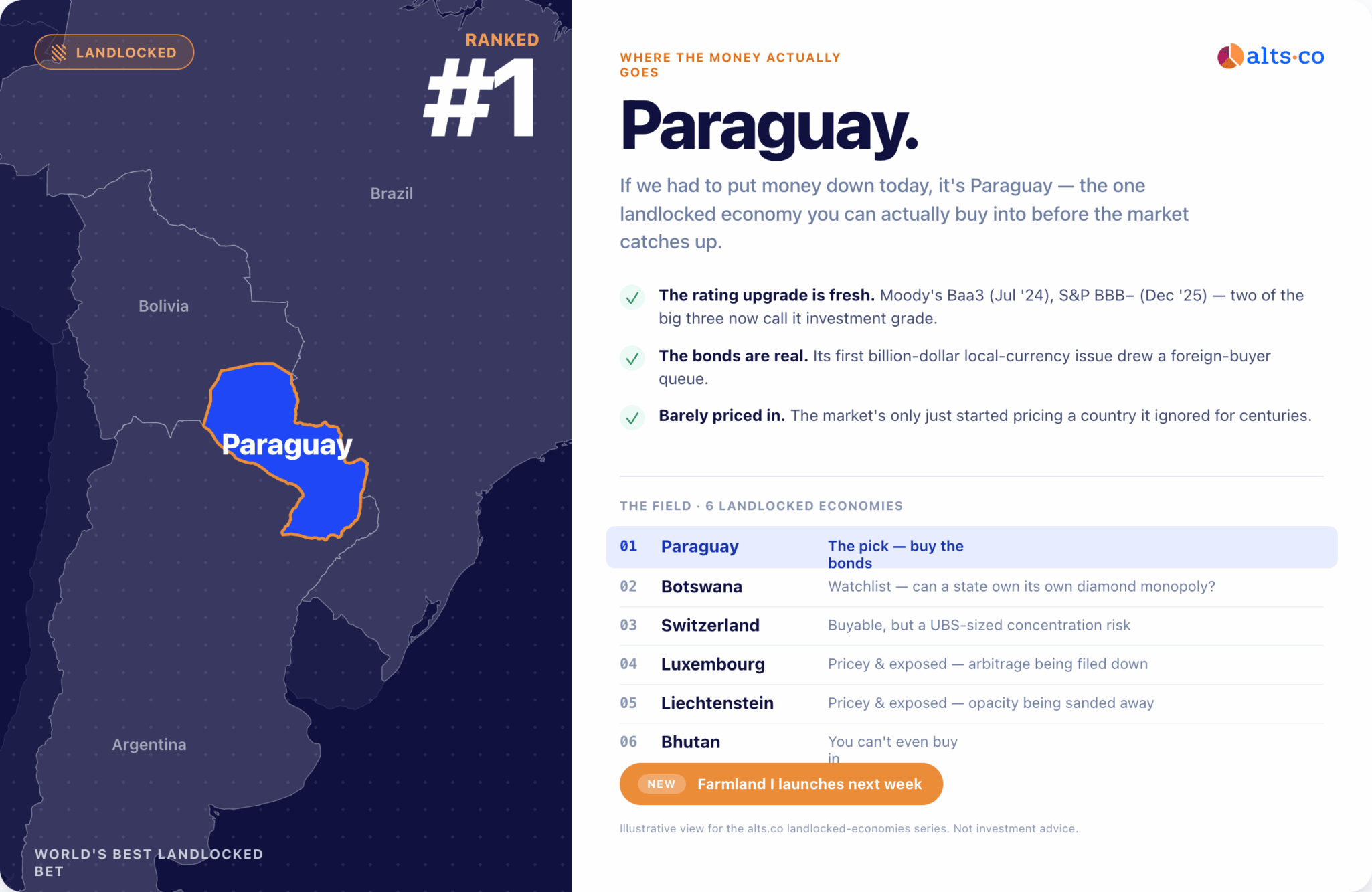
If I had to put money down today, it’s Paraguay.
And not just because we’re launching Farmland I next week!
The rating upgrade is fresh, the bonds are real, and the market’s only just started pricing in a country it ignored for centuries.
Botswana goes on the watchlist, purely to see if a government can pull off owning its own diamond monopoly outright. You can’t even buy a home in Bhutan, and Luxembourg, Liechtenstein, and Switzerland are very expensive and very exposed.
Cheers,
Wyatt
 |
|
The piece's spine is "geography is destiny" and then six countries disprove it in sequence. But there's a common thread running through all six that's more specific than creativity. Every one of them identified an export that doesn't need a shipping container.
Paraguay exports electrons. Botswana exports a governance structure around a rock. Luxembourg exports legal wrappers. Bhutan exported Bitcoin mined with wasted hydro. Liechtenstein exports foundation law. Switzerland exports trust. None of them beat geography by getting access to the sea. They beat it by finding something more valuable than a port and building the entire economy around shipping it without a ship.
The Bhutan section is the wildest. A country running a state-level treasury desk from a mountain range, quietly selling 9,000 Bitcoin across eighteen months without moving the market. That's more sophisticated execution than most institutional funds manage.