

Let's make difficult choices


📅 January 21, 2026 📖 Read time: ± 12 minutes
Welcome to the WC.
Last week, I ripped the lid off America’s Great Ageing Scam. Unless your parents are worth north of $3.5m, odds are even they’ll die broke, and the inheritance you’re waiting for is never coming.
Moreover, America spends trillions per year funding this outcome.
This week, I’m going to present you with a couple of scenarios and ask you to make a tough choice. I’m very, very curious to see where people land on this.
Let’s go 🚀

🚀 Pre-IPO deals in AI, space, and defense
Goodfin is a private markets platform that gives accredited investors access to curated high-conviction pre-IPO companies in hot sectors, especially AI infrastructure, space and defense tech.
The platform is gaining momentum with accredited investors serious about building portfolios with pre-IPO deals traditionally only available to institutions.

The deal flow is already quite impressive. Past deals include Scale AI, Apptronik, Cerebras, and more.

Start here
If you’re accredited, sign up here
You’ll see an intelligent interface where you can research, browse and directly invest in hand-picked pre-IPO offerings.
Just ask G!
Goodfin Premium (Exclusive offer)
Goodfin’s Premium Membership offers investors access to all deals on the platform, no minimums on investments, and access to virtual and in-person members events.
Special for Alts subscribers
After creating an account, go to Memberships, select Premium, and enter code: ALTS750. This will:
✅ Waive the one-time membership initiation fee
✅ Give you a $750 credit to use towards your first investment. This will be credited after membership has been processed.
If you’re accredited and interested in applying AI to your pre-IPO pipeline, create an account.
Use code ALTS750 to unlock this exclusive offer on a Premium Membership
Disclosure: Offers are open to accredited investors only. Offer is only available for first time Goodfin members and for the first year of a Premium membership. Goodfin is not a registered broker-dealer or investment advisor. Private investments are illiquid and carry risk, including loss of capital. Past performance is not indicative of future results.

🧓🏽 The Status Quo
America’s current policy toward ageing is to bleed the elderly dry, then subsidise their final years via Medicaid and Medicare
Every year, America spends roughly $3 trillion on Medicaid, Medicare, and Social Security. That’s nearly half of all federal spending.
This spending extends average life expectancy by approximately 18 months for Americans aged 65 and older. The humanitarian value is real, but the marginal return is diminishing: we spend more each year for incrementally smaller gains in quality-adjusted life years.
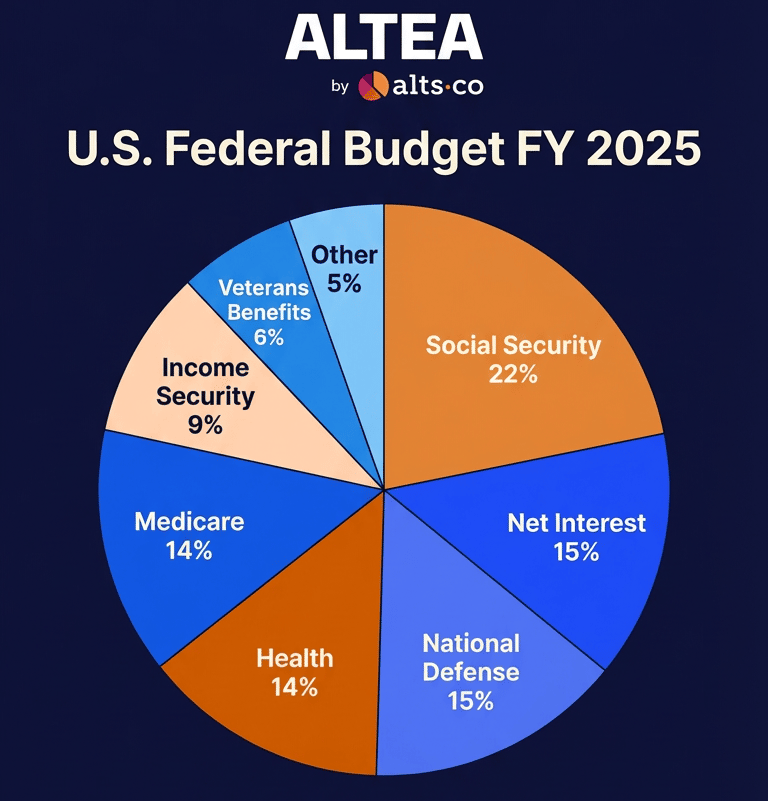
And that trend is increasing.
According to the Congressional Budget Office, 87% of spending growth over the next decade will come from Social Security, health programs, and interest on the debt we’re accumulating to pay for the first two.
By 2034, Social Security will hit $2.5 trillion annually. Federal health programs hit $2.8 trillion.
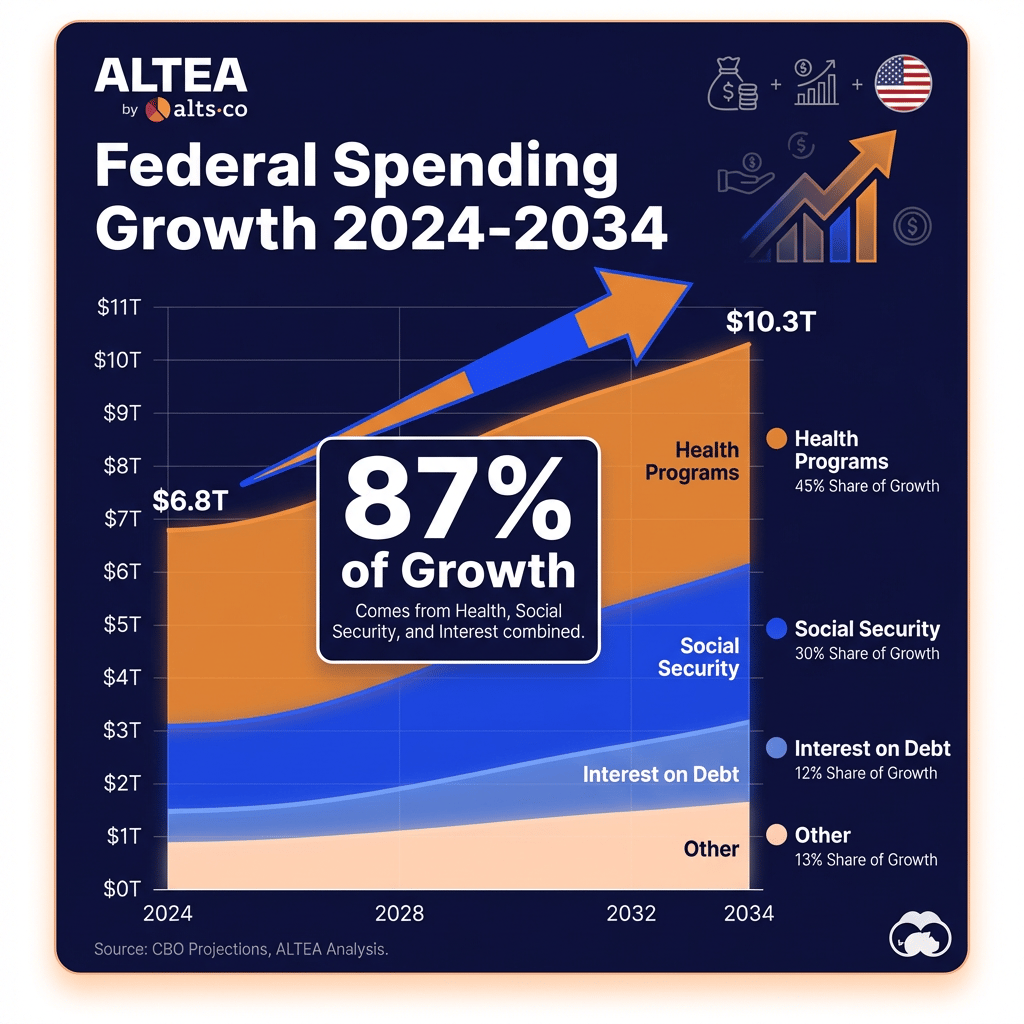
That’s $37 trillion over the next nine years.
This is the status quo. Where America is going right now. Better or worse, like it or not, right or wrong, that’s the path America finds itself on.
Today, I’ll present you with an alternate reality. A thought exercise not unlike the trolley problem:
A trolley is speeding down the line and is on course to smash into five people. You control the tracks and can divert the trolley onto another line with only one person on it.
What would you do? Stand idle and let five die? Or divert the trolley and kill an innocent person? Silently witness a greater evil to avoid direct complicity in a lesser one?
Bear this in mind as we walk through everything below.
An alternate reality
Like everything in life, policymaking is about tradeoffs. Money spent on one thing can’t be spent on another. The $37 trillion that American taxpayers will spend caring for their elderly population can’t be spent on anything else.
And maybe that’s fine! But let’s look at what some of those something elses are.
Below, I present four initiatives. Any one of them would transform both America into a 22nd-century civilisation. Reallocating $37 trillion over the next nine years pays for all four.
💊 Project 1: The “Methuselah” Initiative
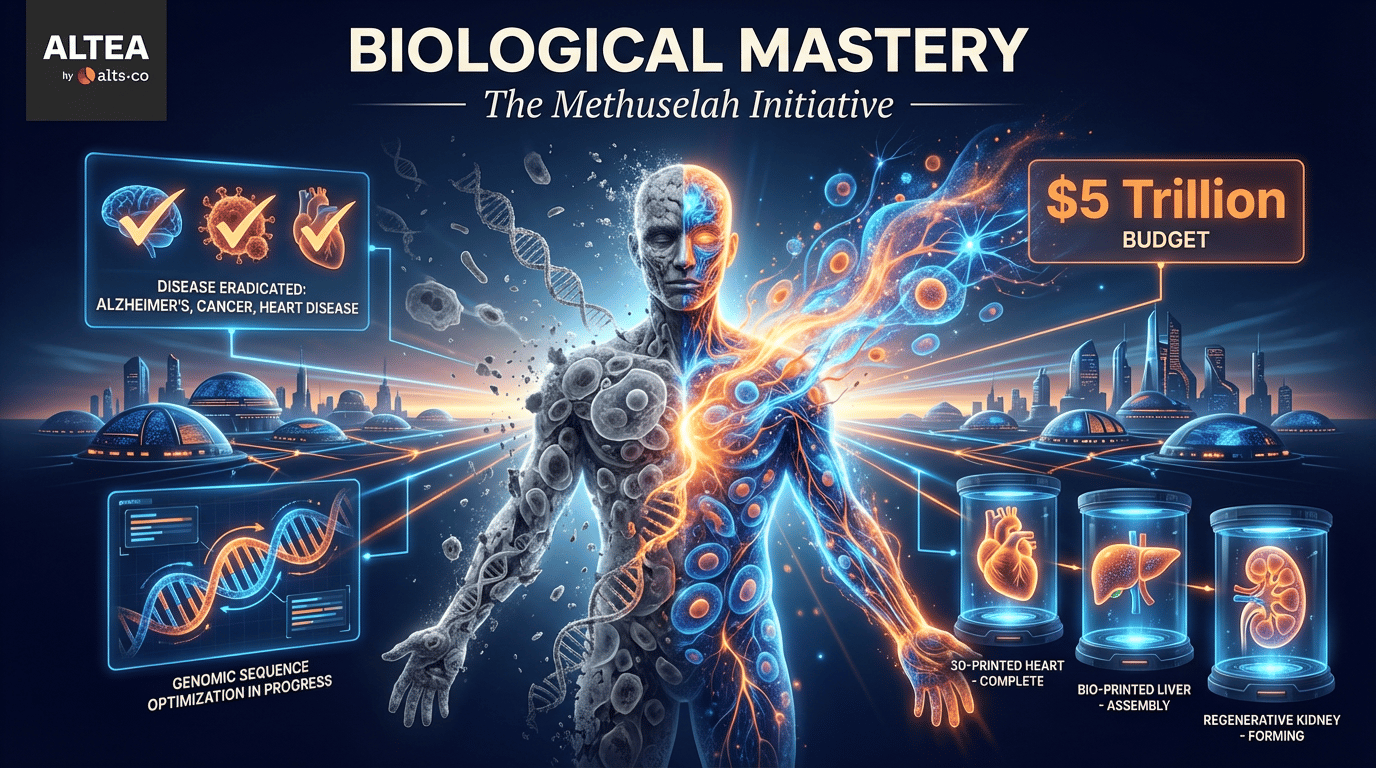
The four leading causes of death and disability in America are Alzheimer’s disease, cancer, heart disease, and stroke. Together, they kill over 1.8 million Americans annually and cost the economy over $1.5 trillion per year in healthcare and lost productivity. Current research funding is a fraction of the costs of the diseases.
Goal: The complete eradication of the top 10 killers of the elderly (Alzheimer’s, heart disease, cancer) and the deceleration of cellular aging.
Cost: $500 billion annually
Scope
The Manhattan Project for Biology: Establish 50 massive, localized research cities (like Los Alamos) dedicated solely to individual diseases.
Universal Bio-Scanning: Every citizen receives a Genomic Sequence and annual MRI/blood biopsy to catch disease at Stage 0.
Regenerative Manufacturing: Industrial-scale 3D printing of organs (hearts, livers, kidneys) using the patient’s own stem cells to replace failing parts before they cause death.
Benefits
Humanitarian: It ends the “long goodbye” of dementia and the agony of cancer. It transforms “old age” from a period of disability into one of extended vitality.
Economic: The “Longevity Dividend.” An Oxford/London Business School study estimated that extending healthy life by just one year is worth $38 trillion to the global economy. Curing aging effectively doubles the productive lifespan of every human, permanently solving labor shortages.
Societal: It eliminates the fear of aging. Grandparents remain active, athletic participants in their grandchildren’s lives rather than burdens.
🧒🏽 Project 2: The Apollo Generation
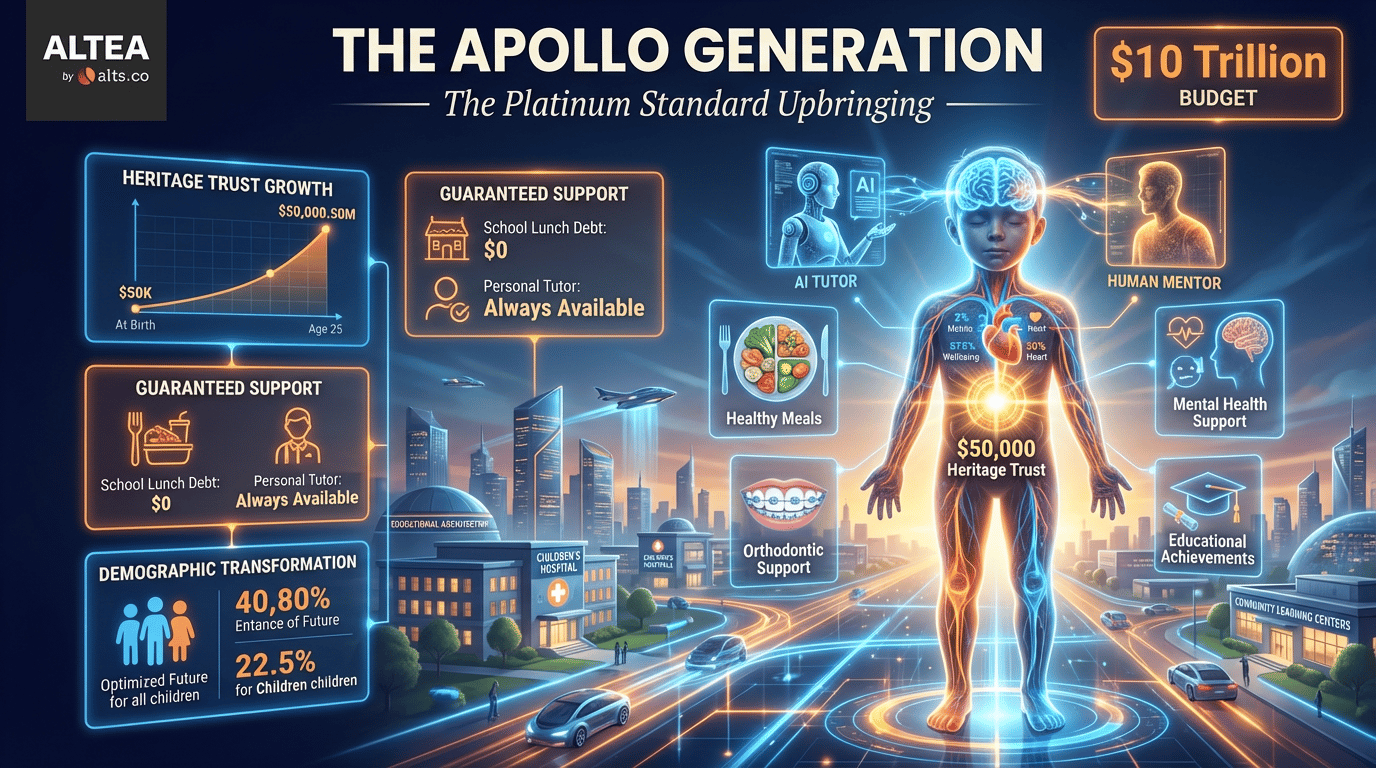
While America spends $5.3 trillion annually on its elderly population, investment in children remains fragmented and inadequate. The economics strongly favour early intervention: every dollar spent on high-quality early childhood programmes returns $7.30 to society.
Further, childcare challenges cost the US economy $122 billion annually in lost earnings, productivity, and revenue. 24% of working parents’ income goes to childcare. In 33 states, infant care costs more than in-state college tuition. 51% of stay-at-home parents would enter the workforce if affordable care were available.
Goal: Move from “warehousing” children in schools to aggressively optimizing the potential of every single American child.
Cost: $550 billion annually
Scope:
1:1 AI & Human Tutoring: A hybrid education model where every student has a personal human mentor and an AI tutor customized to their learning speed, available 24/7.
Universal Nutrition & Health: A ban on “school lunch debt.” Instead, chef-prepared, nutrient-optimized meals for 3 meals a day, plus full orthodontic, mental, and physical healthcare coverage from birth to 21.
The “Heritage” Trust: The government deposits $50,000 into a compounding investment account for every child at birth, with the funds unlocked at age 25. (Cost: ~$180B/year, a fraction of the budget).
Benefits:
Humanitarian: Eradication of child poverty, malnutrition, and the “zip code lottery” of education.
Economic: High-quality early childhood education has an ROI of 13% per year. By creating a generation of hyper-educated, healthy, financially stable adults, you build a tax base that ultimately funds the entire system.
Societal: Crime rates would plummet (crime correlates strongly with childhood poverty). The US would become the global magnet for families, reversing demographic collapse.
🚅 Project 3: The National Aero-Maglev Network
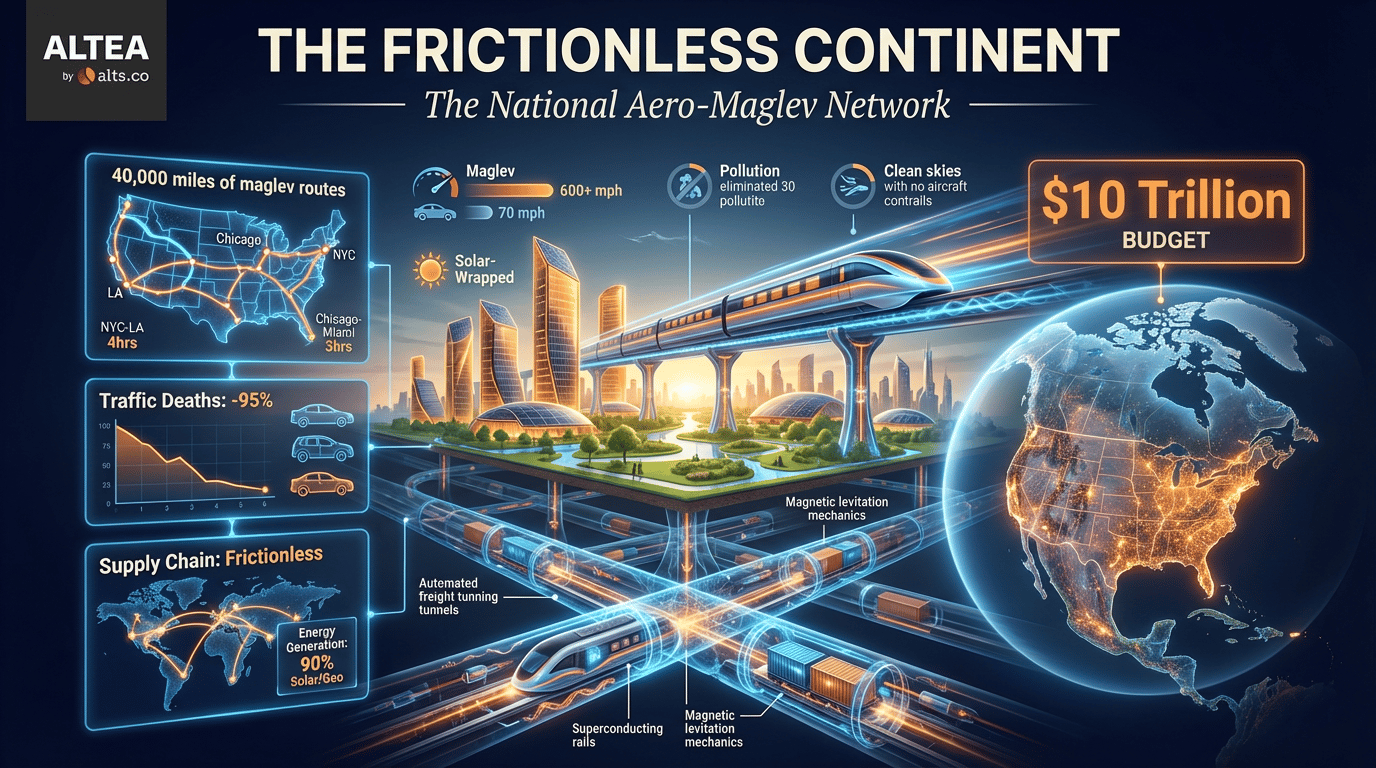
America’s infrastructure is failing. The American Society of Civil Engineers grades it at C overall, with some categories receiving D grades. This deterioration costs every household $2,000-2,700 annually in vehicle repairs, wasted time, and economic inefficiency.
ASCE 2025 Report Card findings: $9.1 trillion needed across 18 categories to reach good repair. Current investment trajectory provides $5.4 trillion over 2024-2033, leaving a $3.7 trillion gap. If funding reverts to pre-2021 levels (before the Infrastructure Investment and Jobs Act), the gap widens further.
Goal: Eliminate domestic short-haul flights and long-haul trucking.
Cost: $10 Trillion total
Scope:
Superconducting Maglevs: A 40,000-mile network of vacuum-tube trains (Hyperloop-style) connecting every major US city at speeds of 600+ mph. NYC to LA in 4 hours.
Subterranean Logistics Grid: An underground, automated freight network for pallets and parcels. Trucks are banned from city centers; goods are delivered to buildings via automated lifts.
Energy-Positive Cities: Retrofitting every building in America with solar skins and geothermal piles, turning the housing stock into a decentralized power plant.
Benefits:
Humanitarian: Traffic fatalities (currently ~40,000/year) drop to near zero. Pollution-related respiratory diseases vanish as ground transport electrifies and moves underground.
Economic: Supply chain friction is eliminated. The cost of shipping drops by 80%, making American manufacturing hyper-competitive globally.
Societal: The “death of distance.” You can live in the Rocky Mountains and work in San Francisco, commuting in 45 minutes. The housing crisis eases as land 200 miles from city centers becomes viable for daily commuters.
😎 Project 4: The Dyson Swarm & The Belt Initiative
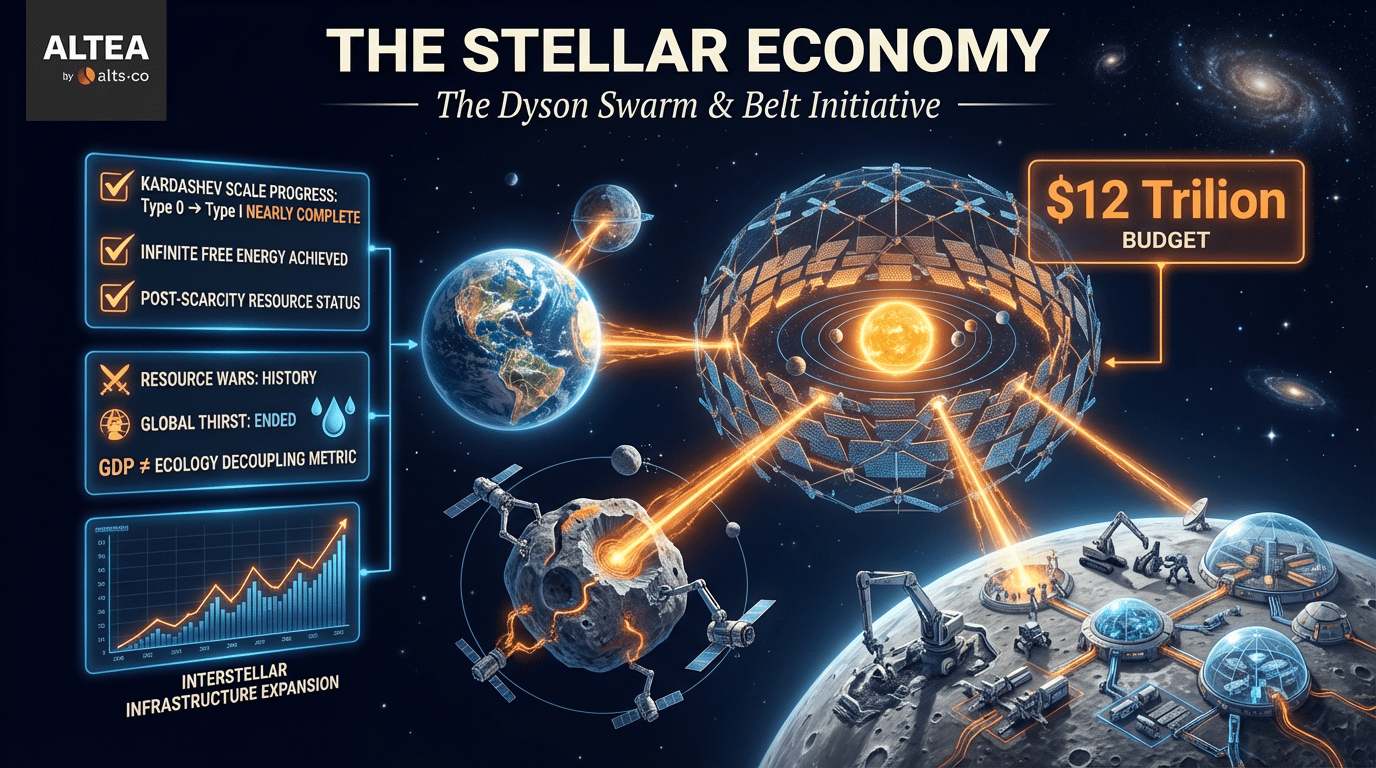
Space contains effectively unlimited resources. The asteroid belt alone holds more mineral wealth than has been mined in all of human history. Mars offers humanity a second home. The economics are speculative, but the potential is civilisation-changing.
Over 700 known asteroids are valued at more than $100 trillion each. The asteroid 16 Psyche contains between $100,000 quadrillion and $700 quintillion in metals. A single 30-metre platinum asteroid could be worth $25-50 billion.
Goal: Infinite energy and post-scarcity resources.
Cost: $12 Trillion total
Scope:
Dyson Swarm Precursor: We can’t build a solid sphere, but we can launch a “swarm” of millions of mirror-satellites around the sun. It beams concentrated microwave energy back to Earth (and Moon bases), supplying nearly infinite energy to everyone on the planet.
Industrializing the Moon: A permanent, robotic mining base on the lunar south pole to extract water and Helium-3, serving as the shipyard for deep space.
Asteroid Capture: Robotically capturing a metallic asteroid (like 16 Psyche) and parking it in lunar orbit to mine for platinum, cobalt, and nickel.
Benefits:
Humanitarian: The end of resource wars. “Infinite free energy” means water desalination becomes cheap, ending global thirst.
Economic: A complete decoupling of GDP from Earth’s ecology. We stop tearing up the Earth for minerals and start harvesting dead rocks in space. The energy cost for industry drops to near zero.
Societal: A unifying “frontier” for humanity. A sense of species-level purpose that replaces geopolitical squabbling.
🚋 Do you pull the lever?
This sounds pretty great!
But is it worth the cost?
Would you let the trolley carry on its current path, or would you choose to divert $37 trillion to potentially better use?
Cheers,
Wyatt